 Michael wanted to understand
The Bacterium With a Tiny Boat Motor
A geeky microscopic chase story about how bacteria turn chemical hints into motion using a spinning protein motor, ion flow, and lots of tiny course corrections.
BioWadi
BioWadi team
Published
July 24, 2026
Reading time

A tiny drop lands on a microscope slide. On one side of it there is a chemical hint that, to a bacterium, means roughly: over here is probably better. In the middle of the drop there is one bacterium.
It has no eyes. No brain. No hands. It does not open a navigation app. It also does not have “recalculating route,” because first you need a brain, then a battery, then an argument with the terms of service.
And still, it starts to move.
The weird question is not only how a bacterium swims. The question is how something so small turns a chemical sign into motion, and then into a direction fix when it gets things wrong. The answer sounds as if someone built a toy boat inside a living cell, then replaced all the screws, wheels, and propeller with proteins.
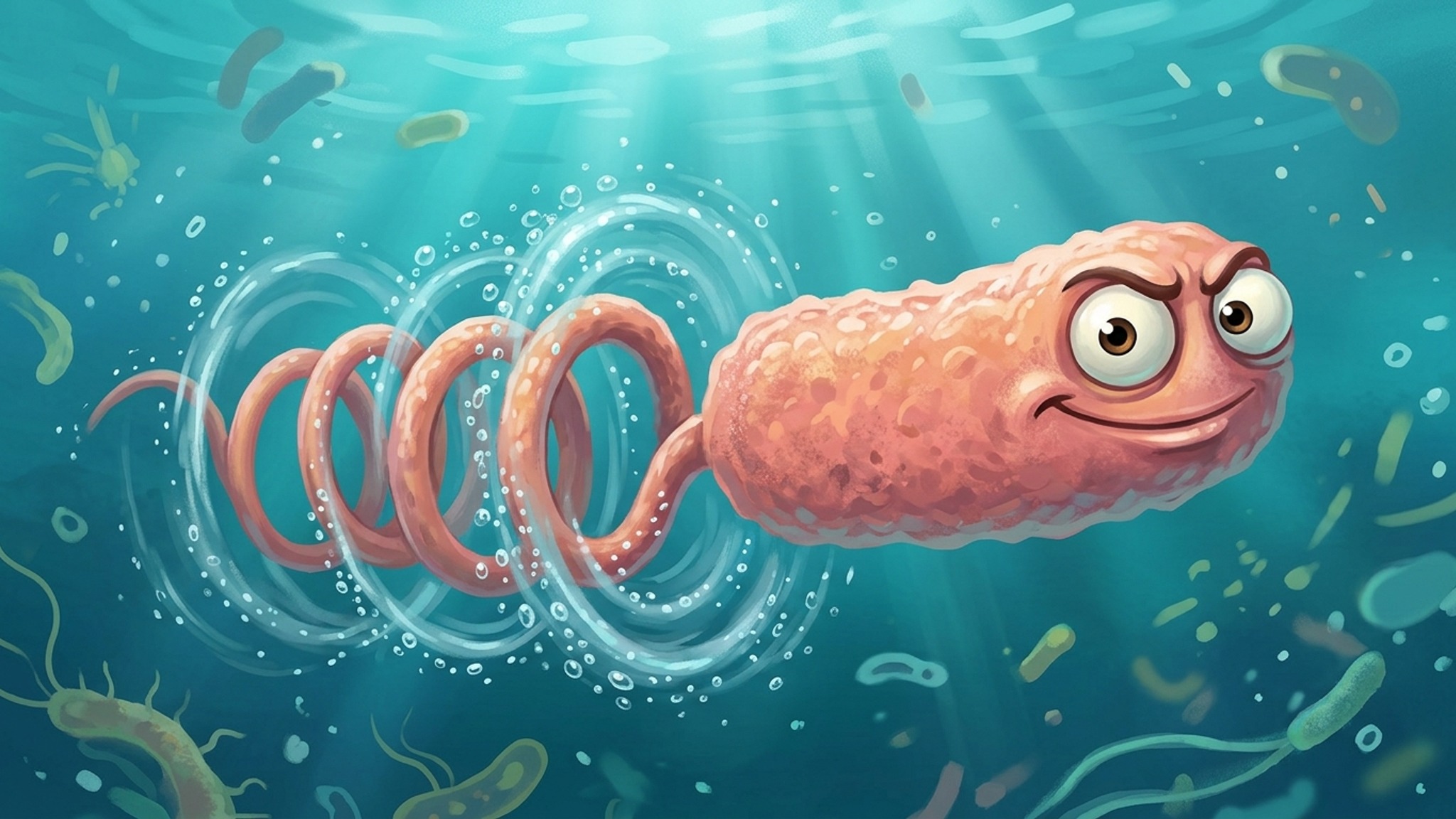
It’s Not a Tail. It’s a Propeller
The thing sticking out of the bacterium is called a bacterial flagellum. It is easy to imagine it as a tiny tail waving from side to side, because our brain sees something long at the back and says: obviously, tail. Thanks, brain, but this time you were impressively confident and wrong.
The flagellum is not a soft tail flapping like a fish. It is a helical propeller that rotates. Like a tiny screw in water, except this screw is attached to a machine inside the cell envelope.
This is where proteins stop being a general word about food or muscles and start being machine parts. One protein can be a beam. Another can be a channel. Another can be a rotating part. Another can stand still and give tiny pushes. In a typical bacterial flagellum there are about 30 different kinds of proteins, and different parts of the structure contain anything from a few copies to tens of thousands of copies. Not bad for something that never took a robotics course.
In the simple version of the story, there are three parts: a motor buried in the cell membrane, a small joint connecting the motor to the propeller, and a helical propeller that stretches several micrometers outside the cell surface. Several micrometers sounds like nothing, until you remember that the bacterium itself is tiny. For it, this is not a hair. This is marine equipment.
TL;DR
- The bacterial flagellum is a rotating helical propeller, not a flapping tail.
- Its motor is built from proteins that sit in the cell membrane and work like machine parts.
- The power source is ion flow across the membrane, not magic and not microscopic gasoline.
- Bacterial navigation is lots of short runs and direction fixes, not thinking with a map.
The Motor in the Cell Wall
A propeller does not spin just because it woke up motivated. If there is a propeller, something has to turn it.
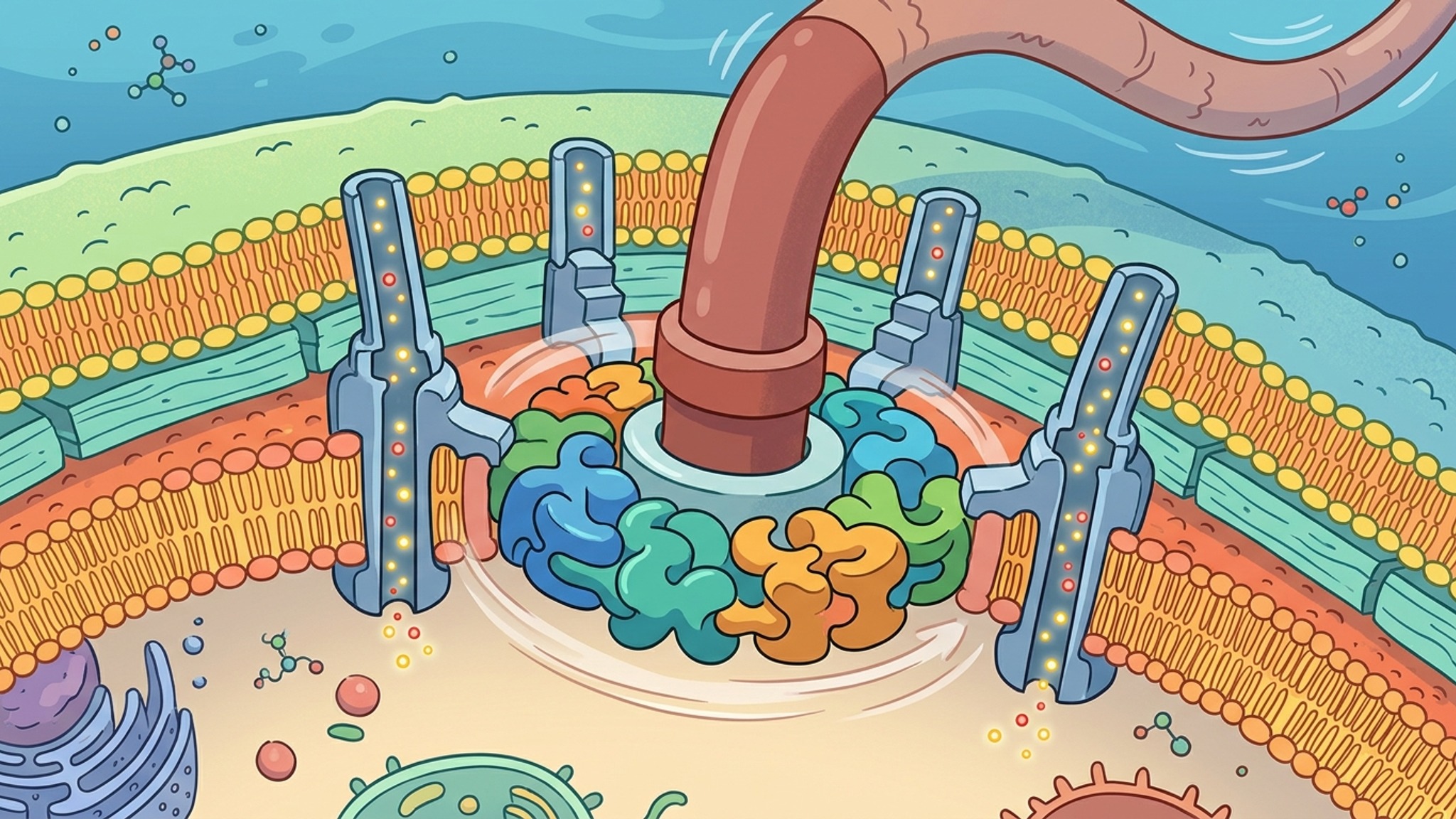
Inside the cell membrane sits the flagellar motor. It has a central part that rotates, and around it several stationary units. Let’s call them here “the fixed pushers”: they do not go on walks by themselves, but sit around the rotating part and make it turn.
How do you push something so it rotates? Think of a revolving door. If you push exactly in the middle, not much happens. If you push at the edge, it spins. In the bacterial motor the pushes are much smaller, but the idea is similar: not a forward push, but a push that creates rotation.
Now we still have to ask who pays the motor’s electricity bill. There is no gasoline here, no garage, and no dad saying, “Don’t touch the engine, it’s complicated.” The power source is a difference between the two sides of the membrane: ions, which are charged particles, are in a state where they can flow through a suitable passage. When they pass through channels in the stationary units, their movement helps turn energy into rotating motion.
It is a bit like water pressure turning a tiny turbine. Except instead of a power plant there is a cell, instead of a pipe there are proteins, and instead of an annoyed technician there is biology making a face that says, “Yes, obviously this works this way.”
Wait, These Are Real Parts?
Yes. This is not a cute metaphor invented so we would not fall asleep.
In familiar bacteria such as E. coli and Salmonella, part of the stationary unit is built from proteins called MotA and MotB. They create a passage that can conduct hydrogen ions, H+. The push that rotates the motor is produced through contacts between MotA and a protein in the rotating part called FliG.
You do not need to memorize the names. Nobody is going to jump out of a flowerpot and quiz you on MotB. The names matter for one reason: they remind us this is not some vague “life force.” These are real biological parts, with location, shape, and function.
And here, too, we have to be careful not to turn one version into the entire world. Some bacteria use hydrogen ions, and some use sodium ions, Na+. There are differences between E. coli, Salmonella, Vibrio, and other bacteria. Biology did not receive one standard specification from the purchasing department and say: from now on, all motors are the same.
The Switch That Stops a Too-Straight Trip
Let’s say the motor works. The propeller spins. The bacterium swims.
Excellent. Now it may swim in the wrong direction.
If a bacterium only pressed “forward” forever, it could move away from the attractive chemical hint just as efficiently as it could move toward it. So the system needs not only a travel mode, but also a correction mode.
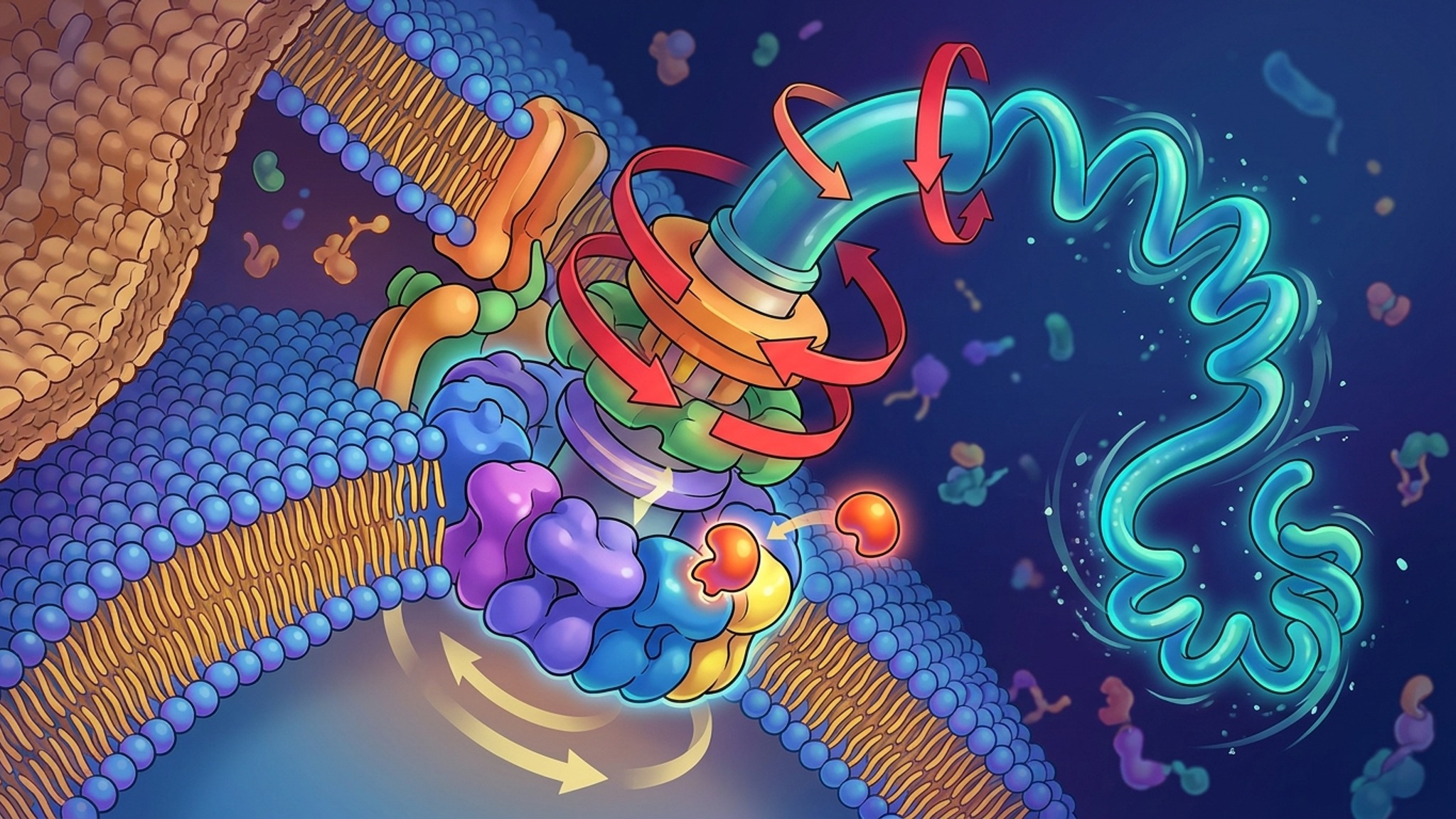
This is where CheY enters. When this protein receives a phosphate group, it becomes a more active version, CheY-P. In that state, it can bind to an inner ring in the motor and change the direction of rotation. In E. coli and Salmonella, that kind of change is linked to a shift from counterclockwise rotation to clockwise rotation. From the bacterium’s point of view, this can turn a relatively straight run into a tumble or a change of direction.
CheY is not a co-driver. It is more like a tiny finger touching the rotation switch exactly when it is time to stop being so sure of ourselves.
Then comes CheZ. It removes the phosphate group from CheY-P. Without the phosphate, CheY lets go of the motor, and the usual rotation returns. Run, tumble, run, correction. Not thought. Not a map. A sequence of states.
How Mistake After Mistake Becomes Navigation
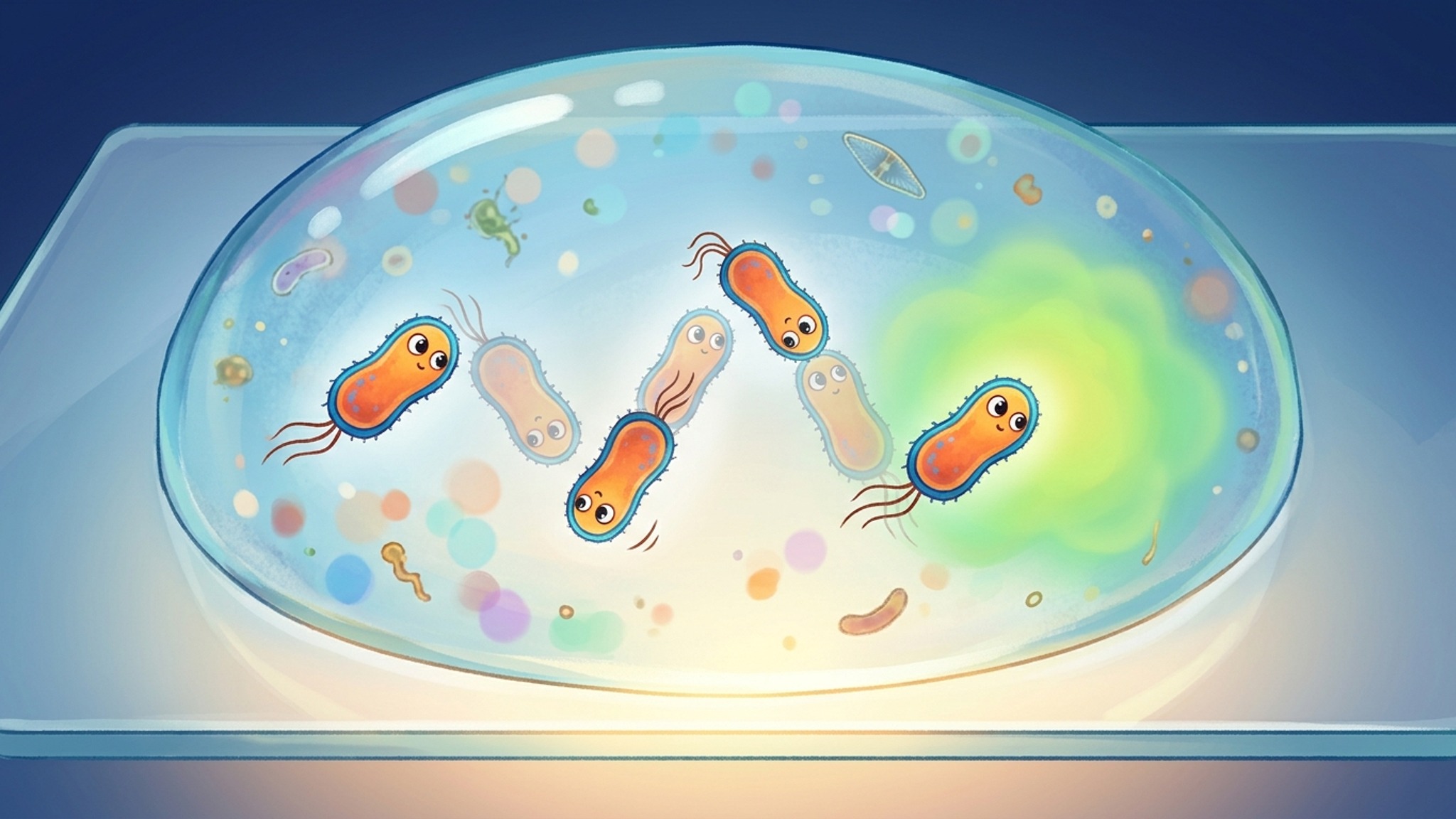
Now we return to the drop on the glass.
The bacterium does not know where “the tasty side” is. It does not see a chemical cloud from far away, and it does not draw a map. Instead, its sensing system helps it compare: is the situation getting better or worse?
When the direction improves, the runs can get longer. When the direction is bad, changes in direction help it try another way. The final path looks less like an elegant line and more like someone searching for the classroom on the first day, but somehow arriving.
And that is the beauty of the story: navigation without conscious thought. Lots of short tries. Lots of small corrections. A spinning motor, a pushing propeller, flowing ions, and proteins that switch states.
What Did They Actually Check Here?
This is where we need to do something the internet is less fond of: look at the kind of evidence.
The main source here is a peer-reviewed review article from 2024. In other words, this is not one new experiment where “they just discovered everything,” but an article that gathers findings from many studies on the bacterial flagellar motor, including work where samples are frozen and photographed with electron microscopes to understand how the parts are arranged.
According to the review, the bacterial flagellum is a very large protein machine in cellular terms: about 30 kinds of proteins, with copy numbers that can range from a few units to tens of thousands. The review describes the division into a helical propeller, a joint, and a rotating motor; ion flow across the membrane as the power source; the rotating part and the stationary units; and the connection between MotA, MotB, and FliG in motors like those of E. coli and Salmonella.
It also mentions an important structural update for researchers: in current models of a common pushing unit, the structure fits five type A subunits and two type B subunits. That is a lovely detail, but it is not the headline for a hungry kid standing in front of cereal. The headline is that proteins can build a real rotating motor.
Where the Magic Ends and Biology Begins
This story does not mean all bacteria swim the same way. It does not mean all flagellar motors specifically use hydrogen ions. It does not mean one review article proved the whole mechanism all over again by itself.
It also does not mean a bacterium has will, planning, or a “decision” like ours. Those are convenient story words, but the mechanism itself is drier and more amazing: sensors, proteins, ions, rotation, a state change, and another try.
There is no medical advice here, no “good bacteria or bad bacteria,” and no story about treatment. This is a foundation chapter in the bacteria-proteins series: how motion can come out of structure.
Wait, So What Should You Take From This?
Imagine the drop again. On one side, an attractive chemical hint. In the middle, a tiny bacterium. Behind it, a helical propeller.
The bacterium did not think its way to the tasty side. It spun a propeller, let ions power a motor, switched states when the direction got bad, and lots of tiny mistakes turned into progress.
Dinner-table question: if you had to build “navigation without a brain,” would you rather have more sensors, more speed, or more tumbles?
Sometimes what looks like thought is actually a tiny machine spinning well enough that life does not stay in one place.