 Michael wanted to understand
The Night Market Inside Your Belly
A geeky trip through the gut microbiome: how microbes turn leftovers into tiny molecules, why that matters, and why a shiny probiotic sticker still has to prove itself.
BioWadi
BioWadi team
Published
July 17, 2026
Reading time
A tired parent stands in front of an ordinary dinner plate. Not a royal banquet. A bit of vegetable, something grainy, maybe yogurt, maybe a leftover from the fridge that has already started considering an independent career.
The bite goes down. From the outside: nothing. No explosion. No suspense music. No cell sends a thank-you email.
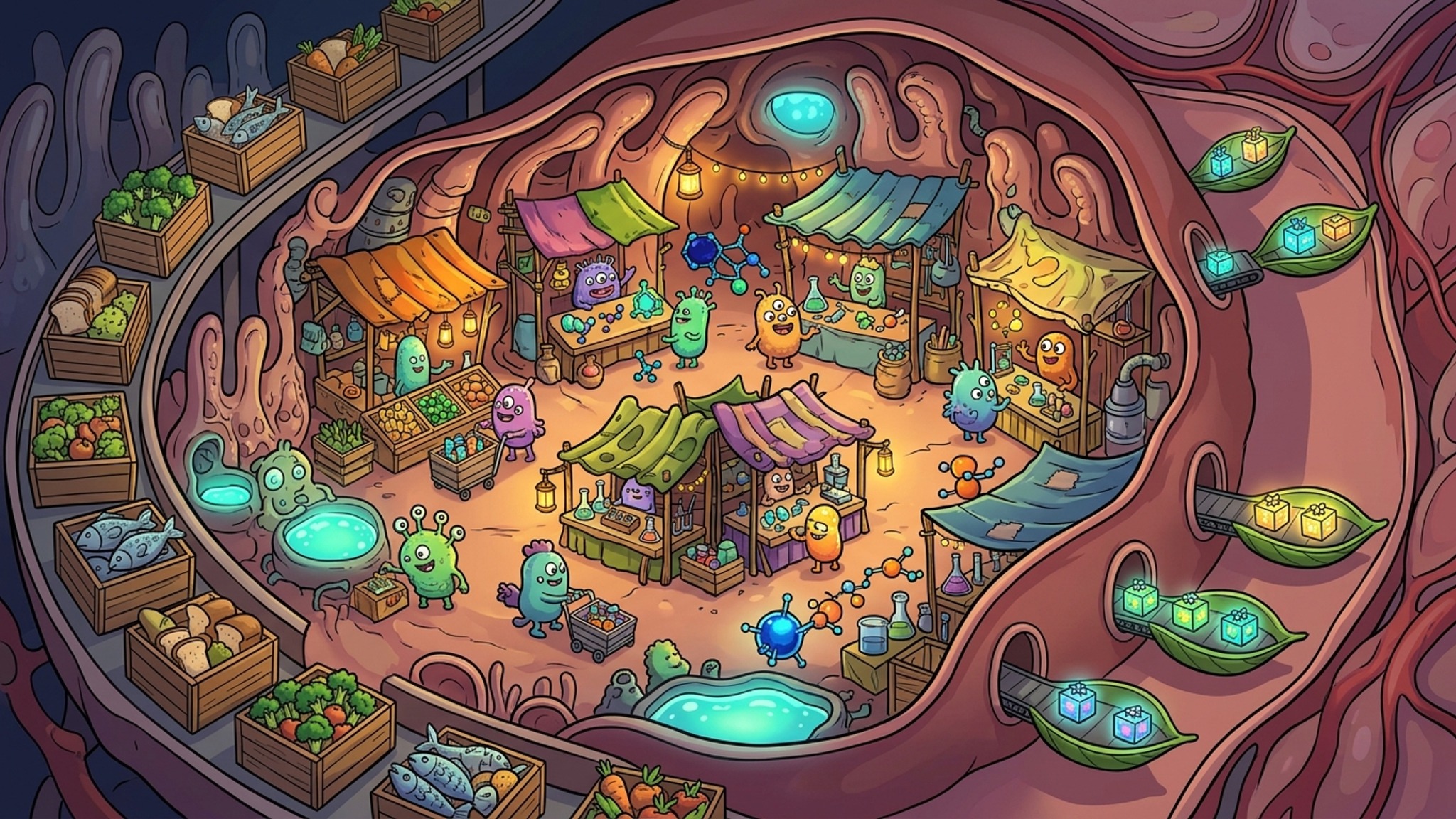
But part of that delivery keeps traveling into the gut, and there a crowded, damp, chemical night market opens for business. No falafel stand. Microbes. They are not yelling “tomatoes for a shekel,” because a. they do not have lungs, and b. they are busier with the truly important question: what can be broken down, changed, or turned into a new molecule?
The Bite That Arrives After the Human Kitchen Closes
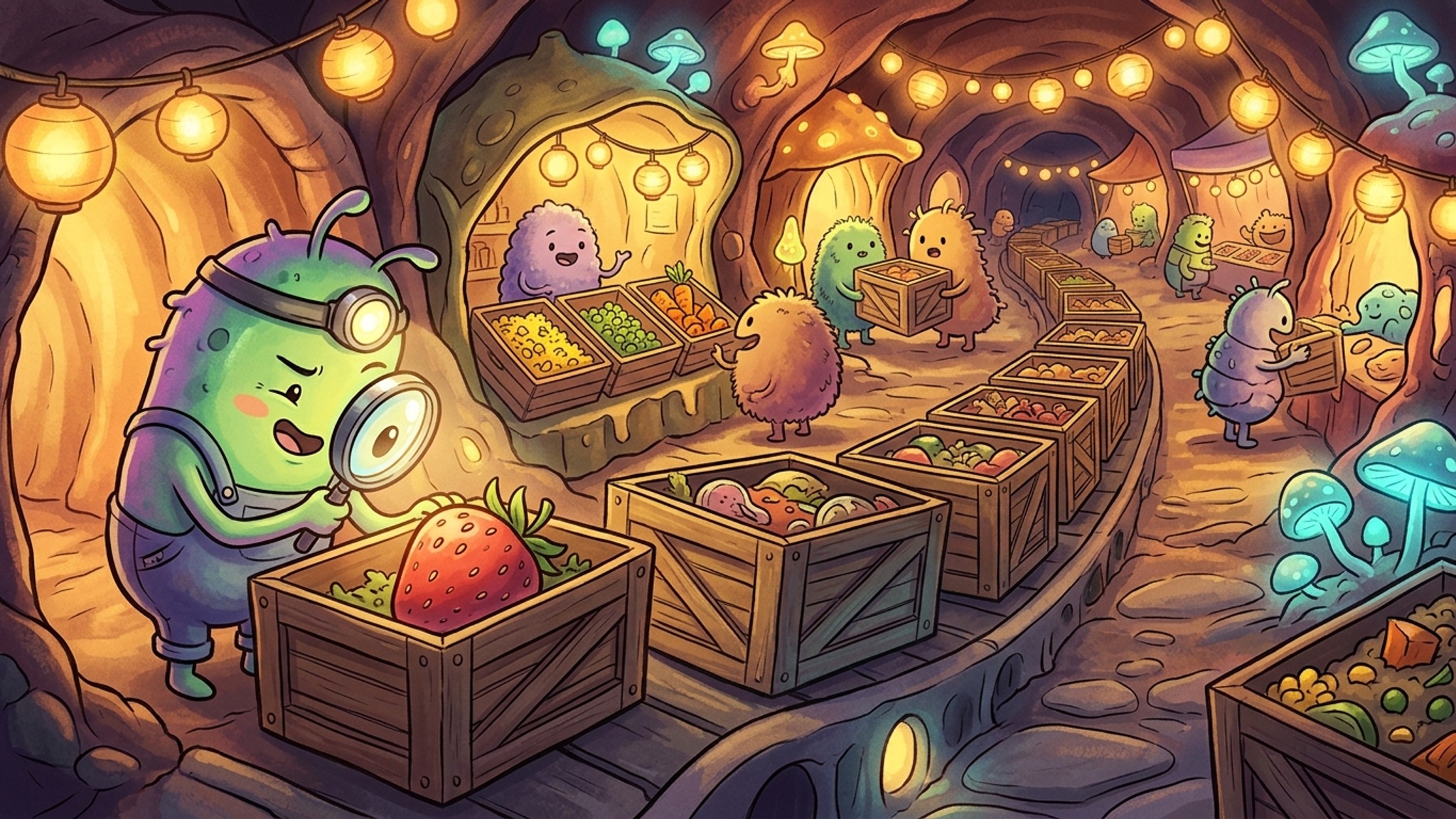
The body breaks down a lot of food by itself, but not everything disappears instantly like a cheap birthday-party magic trick. Certain pieces reach the gut as raw materials. In the market metaphor, these are the crates arriving after midnight. In biology, these are molecules and food fragments that microbes can process.
This is where the microbiota comes in: the actual community of tiny living things, mostly bacteria and other microbes, that live in a particular place such as the gut. They are not biological decoration. An open peer-reviewed review from 2020 describes how the microbiota can strongly shape the host’s biochemical environment, meaning the human body it lives inside.
A host, by the way, is not a landlord trying to collect building fees from bacteria. It is the body that gives them an environment. And that environment is not quiet. It is full of chemical negotiations.
TL;DR
- Some food reaches the gut as raw material that microbes can process.
- Microbiota is the community of microbes; the microbiome is their genetic instruction library.
- Metabolites are small molecules created or changed during chemical activity.
- A link between the microbiome and health is not proof that a specific probiotic product solved anything.
The Stalls Do Not Ask Who You Are. They Ask What Can Be Broken Down
Microbes do not work by good vibes. They work with genes. Genes are work instructions inside a living thing. In microbes, genes determine which chemical jobs they can do: what to break down, what to change, and what to build again.
And here comes a word people mix up a lot: microbiome. It is not exactly another name for microbiota. If the microbiota is all the stall owners in the market, the microbiome is the total genomic content they carry: the recipe books, tools, and instructions. So the question is not only who lives there, but also what chemical equipment they brought with them.
Asking only “which bacteria are there?” is like judging a market by the sellers’ names without asking who can actually cook something edible. Science does need the tenant list, but it also has to understand the work.
That work happens in metabolic pathways: a sequence of chemical stations. A substance enters, changes at one station, moves to the next, and eventually something else comes out. And what comes out? Metabolites: small molecules that are created, broken down, or changed during chemical activity by the body or the microbes.
In a drawing, this looks like packages leaving a stall. In reality, these are molecules that can become part of the chemistry around cells and tissues. Not magic. More like a tiny kitchen with too many recipes and nobody cleaning up properly afterward.

Two Different Markets, Similar Services
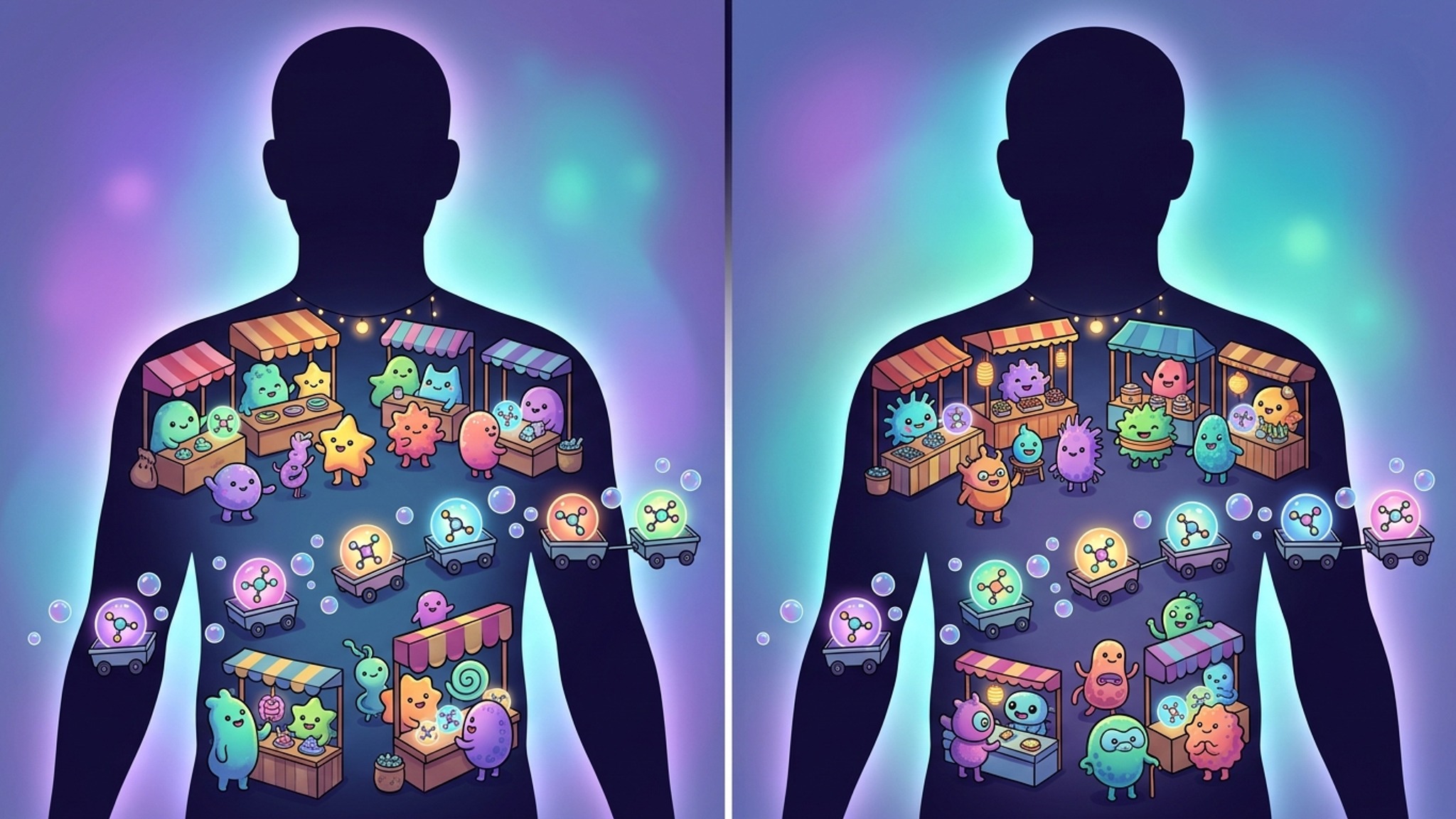
Now comes the twist: in two different people, the microbe list can be very different. Different names, different species, different strains. A microbial strain is a particular version of a microbe; two microbes with a similar family name can work a little differently.
But according to the review, even though the taxonomic composition, meaning which names and types of microbes are present, varies a lot between people, the abundance of certain metabolic pathways is relatively consistent. In less fancy language: the signs over the stalls change, but some of the chemical services keep showing up.
That does not mean everyone is the same. The opposite. Each person also has private shelves. The review notes that every person carries rare microbial strains, and that about half of a person’s microbial gene content may be unique to them. If half your instruction library is private, the body is not running on a standard summer-camp menu.
Dinner-table question: if you were studying a night market, would you check who the sellers are, what they know how to do, or what comes out of the market in the end?
The Inspectors Who Tried to Draw a Map
Once you understand that the body has markets like these, a basic problem appears: how do you map a place when so much of it is tiny, crowded, and different from person to person?
This is where the Human Microbiome Project enters. According to the review, its first phase began in 2007 and sampled 300 participants across several body sites. It was like inspectors arriving with notebooks and flashlights and saying: hold on, where are all these markets, who is in them, and what might they know how to do?
This is not a final map of all humans. It is a more organized beginning for navigating a place that had previously been too dark. And even a good map does not mean everyone selling near the exit knows how to fix your life.
Who Pays for the Sticker at the Market Exit?
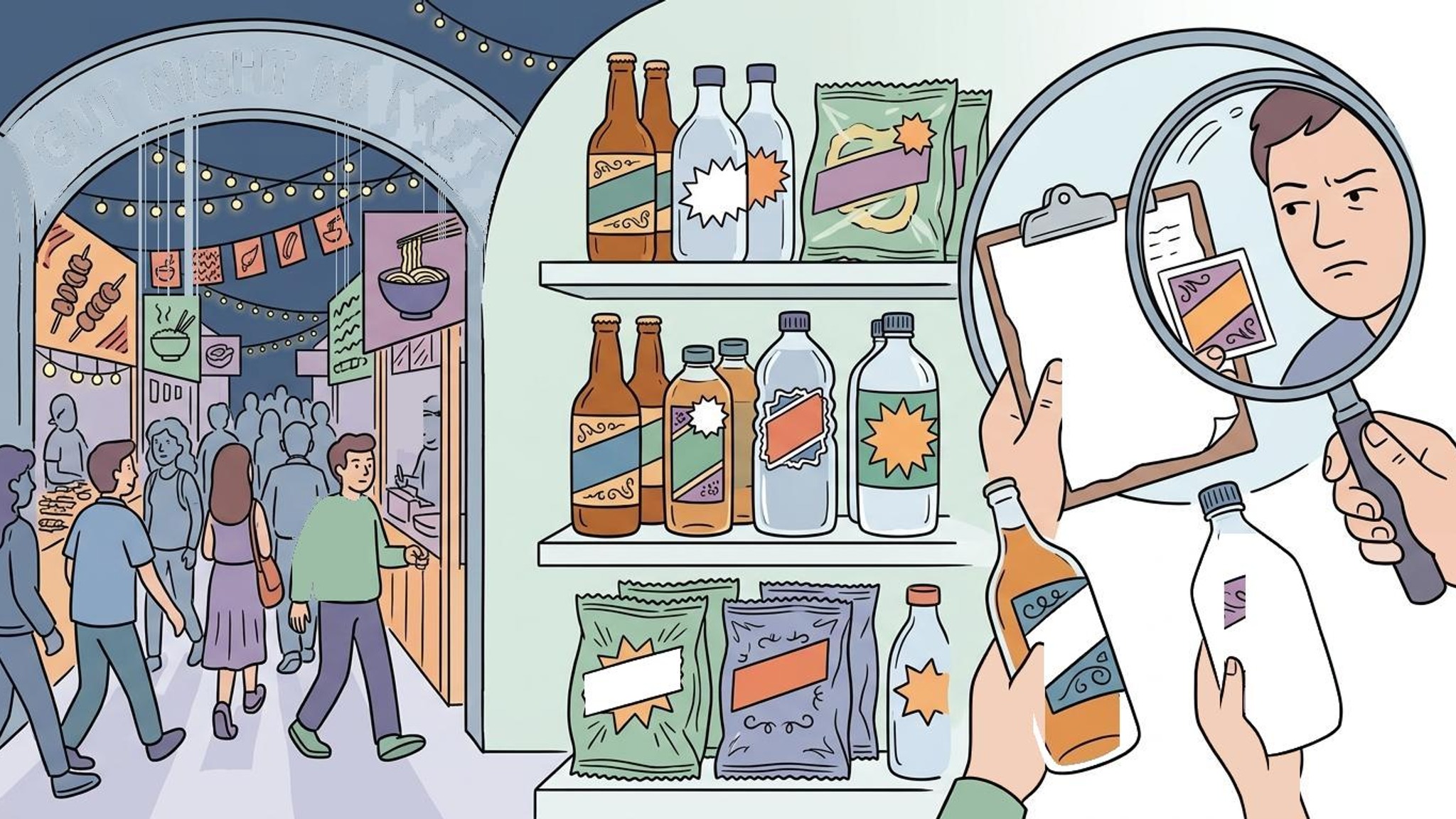
And here science meets the store shelf. Once someone says microbiome, bottles, powders, diets, and stickers promising to be good for your belly show up too. The science is real. The sticker still has to prove it is not just a sticker with self-confidence.
A probiotic is a product or preparation that contains live microbes. A prebiotic is food material meant to encourage certain microbes to grow, as if you sent raw materials to a specific stall in the market. The review does describe that interactions between the microbiome and metabolites are common, can influence human diseases, and are being studied in strategies such as probiotics, prebiotics, dietary changes, metabolite targeting, and fecal microbiome transplantation.
But a product sold to consumers needs its own evidence. Money does not make science false. Money also does not make it true. Money simply means: now there is a big sign by the register, so it is worth asking exactly what was proven, in whom, and in what kind of study.
So What Did They Actually Check?
The source here is an open peer-reviewed review from 2020 about interactions between the microbiome and metabolites. A review is not one experiment that proves a product. It organizes knowledge: what is known about mechanisms, which links have been observed, which methods exist, and where the scientific cheese still has holes.
That is why we have to separate association from causation. Association is when two things appear together. That can be an important clue. Causation is proof that one thing truly caused another, and in science that requires tougher tests than “we saw them in the same room.”
The review supports the idea that microbes and their metabolites are a serious part of the body’s biochemical story. It does not prove that a specific yogurt, capsule, powder, or trendy menu fixes health in a specific person.
So no: the market does not prove that every bottle on the shelf works. Also no: it is not all nonsense. What yes? The gut contains a real, personal, active chemical system, and it deserves more serious research than a slogan on a label.
Where the Magic Ends and the Biology Begins
This market is not a wish machine. This is not a recommendation to take probiotics, change a diet, chase a particular metabolite, or conclude that good microbes repair health like air-conditioner technicians.
A link, a mechanism, and a research strategy are an important beginning. Effectiveness, safety, dose, personal fit, and causation require separate tests, especially when someone is selling you a product.
It also does not mean hunger, digestion, and health are only a matter of tiny bacteria pulling strings. The body is a complicated system. The microbes are important players in the market, not a magic committee running everything from the basement.
Wait, So What Should You Take From This?
The tired parent from the opening thought they had only eaten dinner. In practice, part of the bite entered a night market where tiny living things receive raw materials, activate genetic instructions, run metabolic pathways, and release metabolites that change the biochemical environment around the body.
That is weird enough without adding magic. Understanding that there is a market in your belly is science; believing every sign at the market exit is already shopping.