 Michael wanted to understand
CRISPR: The Bacterium That Kept a Burglar Photo
How a tiny bacterial security trick became programmable DNA scissors, and why “programmable” still does not mean “perfect.”
BioWadi
BioWadi team
Published
July 17, 2026
Reading time
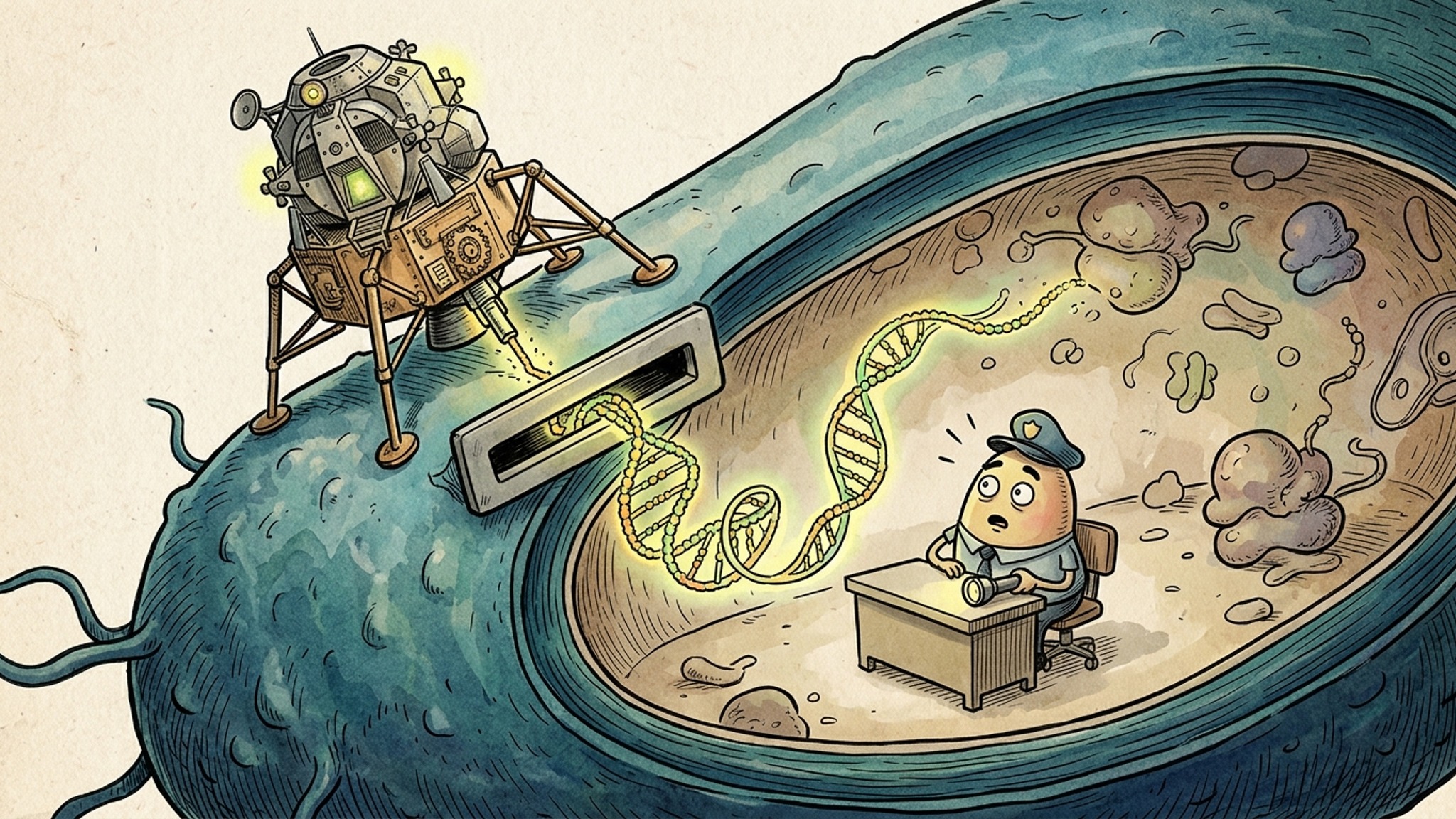
A tiny virus lands on a bacterium.
Not like a shiny spaceship with dramatic music. More like a burglar with table legs and the manners of a vacuum cleaner. It sticks to the bacterium’s wall and injects DNA: an instruction sheet trying to turn the cell into a factory for making more viruses.
The bacterium has no brain, no secret-agent sunglasses, and no furious building committee yelling in the stairwell. Still, some bacteria have a trick that sounds like it was written after too many spy movies: they take a small piece of the intruder’s DNA and store it inside their own DNA.
That is roughly like pinning a burglar’s photo to the wall. Except the wall is made of living code, the photo is a DNA sequence, and the burglar is a virus trying to turn you into a copying machine. Biology, as usual, takes a strange idea and then behaves as if it is a normal office binder.
This Time, the Bacterium Keeps a Photo
Viruses that attack bacteria are called phages. A phage does not need to be big to be rude. It injects genetic material, and the bacterial cell may start making more phages instead of doing its regular bacterial job: living, dividing, and pretending the world is not full of tiny needles carrying DNA.
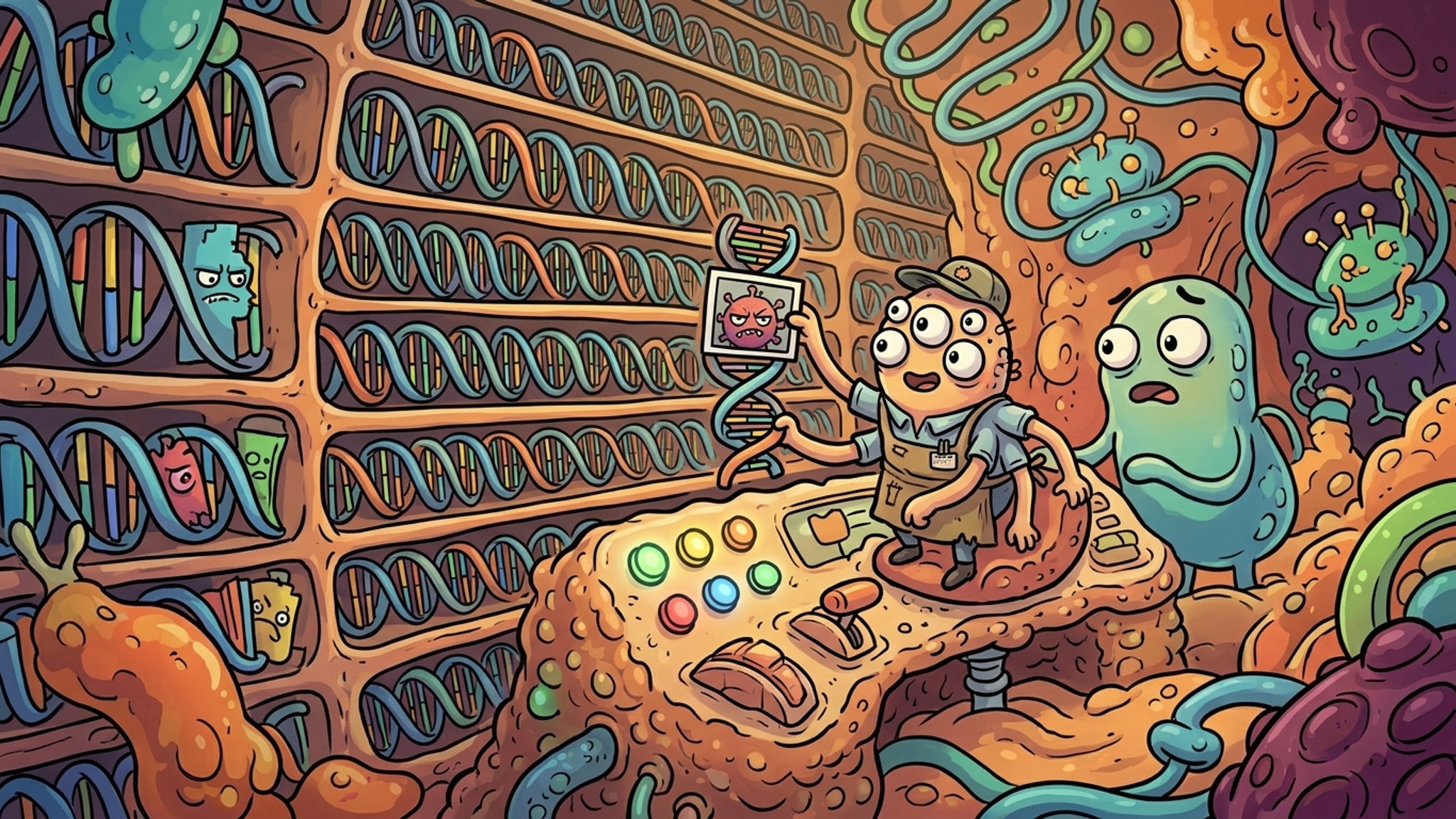
In the CRISPR system, some bacteria keep short DNA pieces from previous invaders. These pieces are called spacers. They sit between repeated DNA sequences, like a genetic security binder full of wanted posters. That binder would probably fail a school bag inspection, but for a bacterium it can save its life.
The scientific review behind this article describes CRISPR as part of an adaptive immune system in prokaryotic organisms, meaning organisms like bacteria, without a cell nucleus like our cells have. Repeated sequences like these were identified as early as 1987 in the bacterium Escherichia coli. Later, scientists realized that the spaces between them, the spacers, can come from viruses or from plasmids, small DNA rings that can move between cells.
In less fancy words: what first looked like boring DNA wallpaper turned out to be a suspect archive.
TL;DR
- A phage is a virus that attacks bacteria and injects DNA into them.
- CRISPR began as a memory-and-defense system: the bacterium stores spacers from earlier invaders.
- Cas9 is the cutting protein, but guide RNA tells it where to go.
- Programmable gene editing is not magic: an address that is too similar can cause a cut in the wrong place.
When the Souvenir Starts Working
A souvenir by itself does not stop a burglar. A photo album does not leap off the shelf and knock someone to the floor, unless it is an especially heavy family album.
Here, memory turns into defense. According to the review, experiments from 2007 supported the defensive role of CRISPR: after bacteria were exposed to phages, they incorporated new spacers into their genome. Later, their sensitivity to being infected again changed according to the spacers they had.
In other words, if the bacterium has a matching piece of the intruder in its archive, the next attack does not start from zero. The cell can compare what just came in with what was stored earlier. A beautiful moment for biology, and an awkward moment for the virus: We have seen you before. We did not miss you.
But someone still needs to do something. A wanted-poster binder does not sprint down the hallway with handcuffs. Who takes the memory and turns it into a cut?
The Note That Leads the Scissors
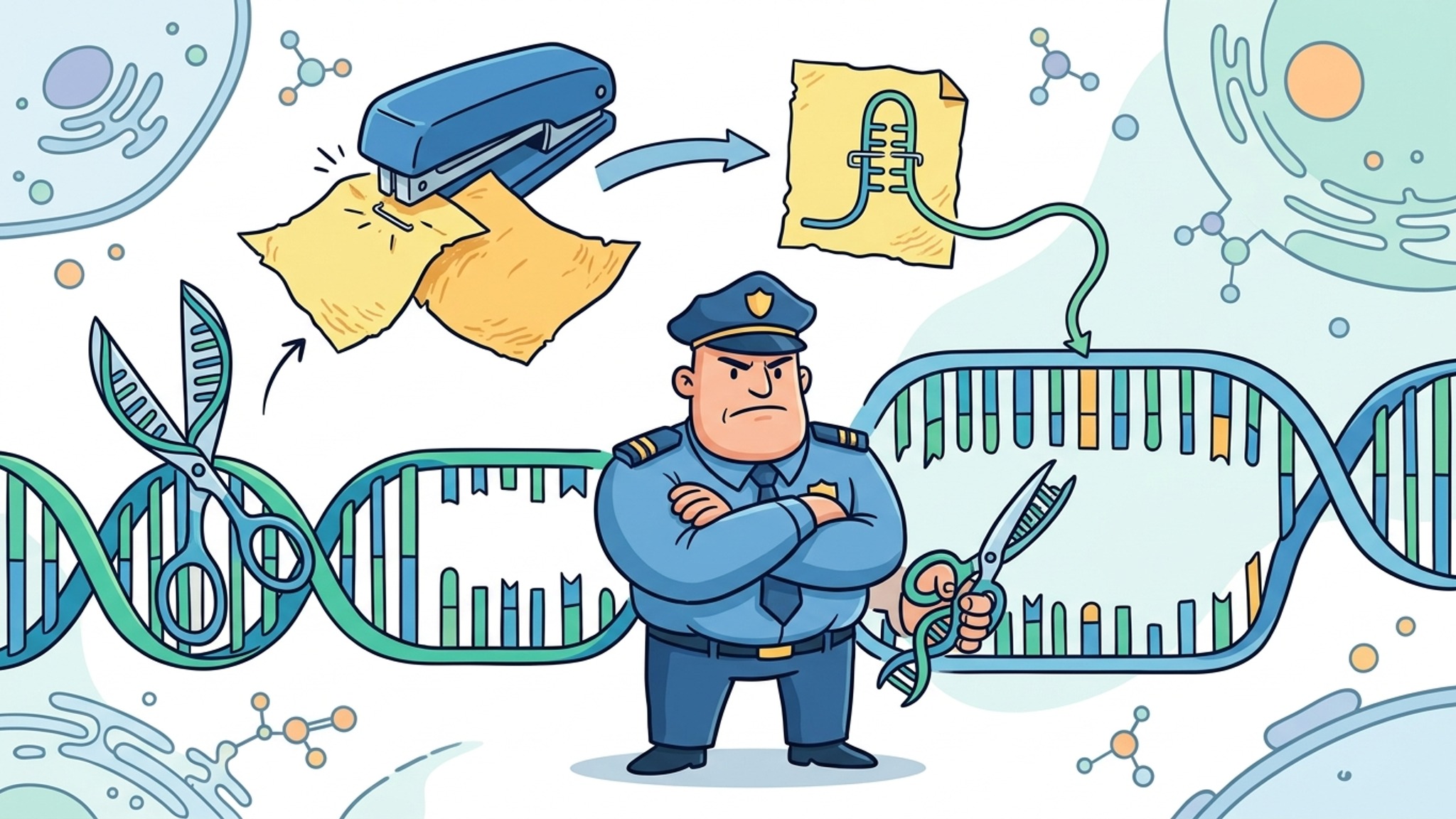
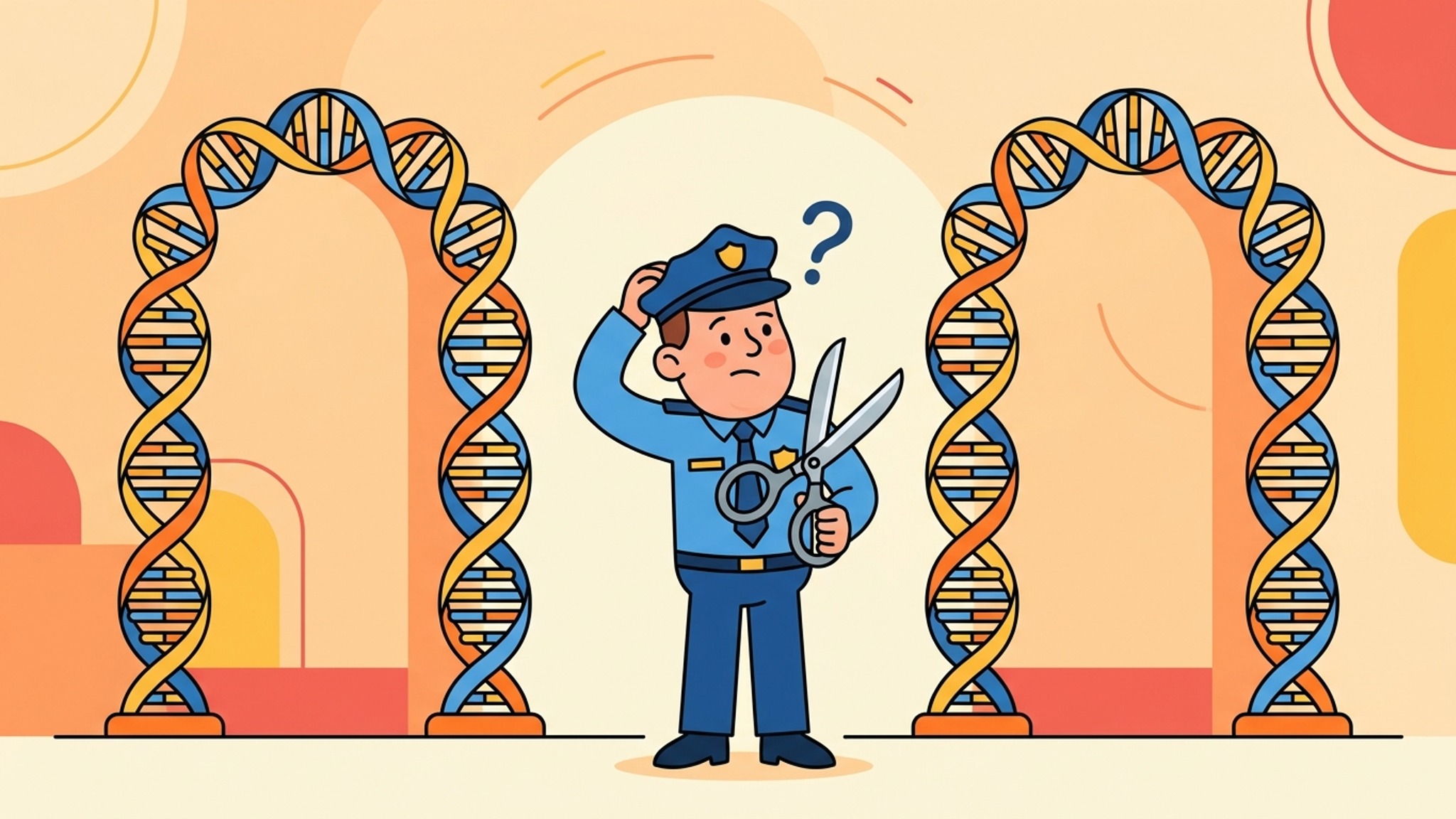
Here comes Cas9, the protein that became the star of gene editing. So it does not get too full of itself: Cas9 is not a ninja genius, and it is not a wizard that smells DNA with its eyes closed. It is a security guard with scissors. A serious guard, yes, but pretty unmotivated without a note.
In the type II CRISPR-Cas9 system, the review describes one central protein, Cas9, that works with two kinds of guide RNA: crRNA and tracrRNA. The crRNA is the address part, the sequence that matches a specific DNA target. The tracrRNA is the helper that lets the system use that guidance. Yes, the names sound like someone fell asleep on a keyboard. The point is simpler: one brings the target address, the other helps make that guidance usable.
Then scientists did a very human thing: they took a complicated system and folded the paperwork. They engineered one guide molecule, single guide RNA, or sgRNA, which connects the two guides into a single guide. Less elegant than magic, much more useful.
When a small part of the sgRNA sequence is changed, Cas9 can be aimed at a different DNA sequence. That is the programming moment: Cas9 did not get smarter. Someone just swapped the address on its note.
The Tiny Badge by the Door
Even a good address is not enough. Cas9 needs to see a short sign near the target called PAM: a sequence of 2 to 5 base pairs located next to the cutting site. In our security metaphor, PAM is a tiny badge by the door. Without the badge, the guard is not supposed to start cutting walls. Finally, bureaucracy with a purpose.
When the guide RNA matches and the PAM is present, Cas9 can cut both strands of DNA. According to the review, inside Cas9 there are two cutting regions: HNH cuts the complementary strand, and a RuvC-like domain cuts the non-complementary strand.
These are not actually cartoon scissors. They are parts of a protein that perform a chemical cut. But the metaphor holds: there is an address, there is a badge by the door, and then there is a cut. Only the page here is not paper. It is living code inside a cell.
Wait, Does That Mean You Can Edit Anything?
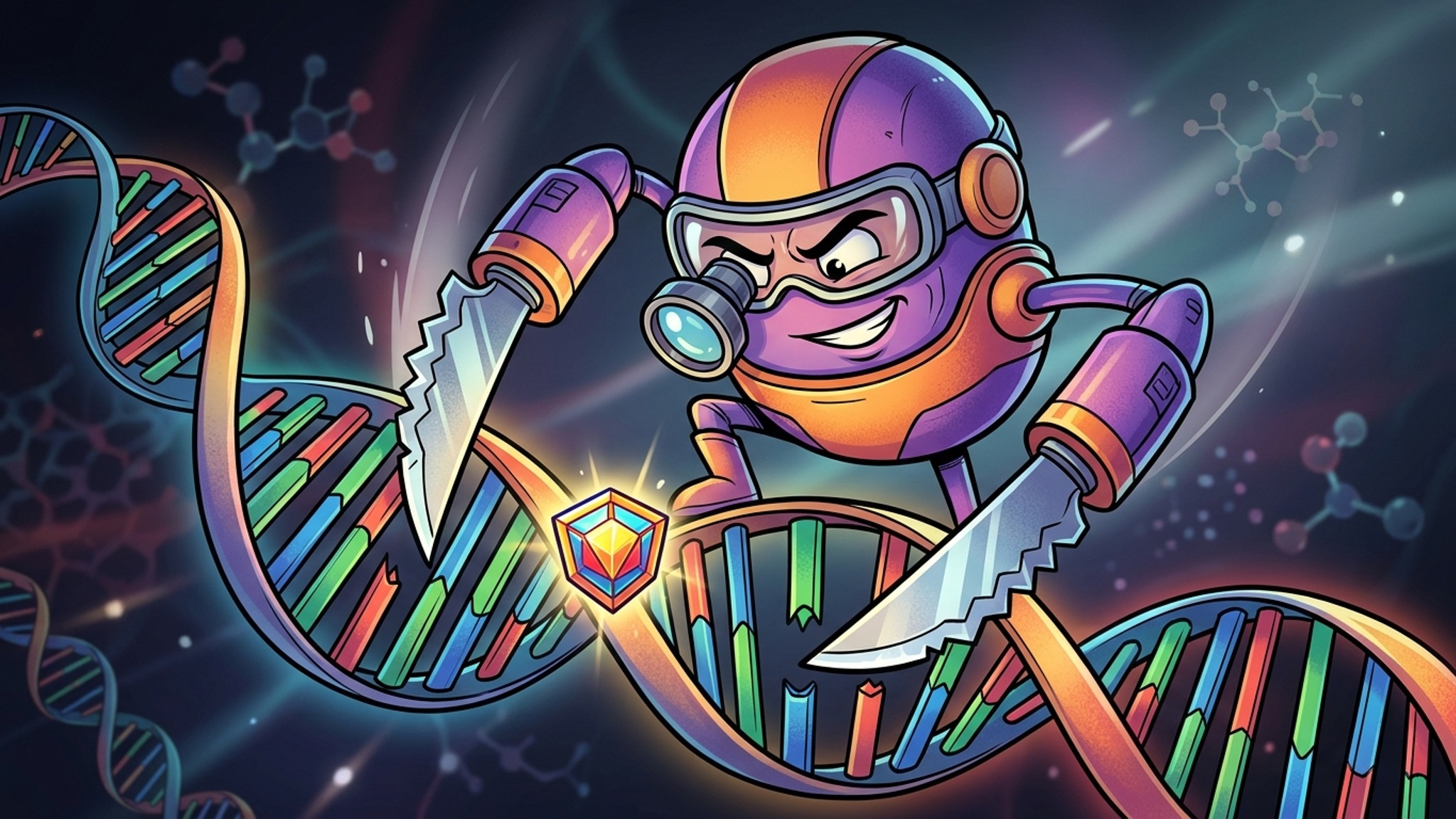
Here the story becomes more human. Genes are pieces of DNA that cells use as instructions for building proteins and running cellular life. Gene editing is an attempt to change that code at a specific place. It is not opening a secret menu for a living creature and choosing eye color, piano memory, and the ability to load the dishwasher without complaining. It is more like entering one sentence inside a giant book and trying to fix one letter without knocking the whole book off the table.
That is why CRISPR matters so much for research. If you can program a guide RNA, you can send Cas9 to check a specific place in DNA. That is useful for scientists who want to understand what a gene does, build disease models in cells, and think carefully about future treatments.
But programmable does not mean perfect. Even GPS sometimes tells you to turn into a parking lot with no exit, and GPS at least is not holding molecular scissors.
When an Address Is Too Similar and Causes Trouble
If the guide RNA is similar enough to the wrong address, Cas9 may cut somewhere we did not want. This is called an off-target mutation: a change outside the target. In DNA, close enough is a terrible sentence. It is a bit like a delivery person bringing pizza to the house next door, except the pizza is molecular scissors.
The review warns that unexpected off-target mutations are a safety problem in medical use, because they may harm cell function or make cells dangerous. It also emphasizes that the delivery method into cells and how long Cas9 remains active can affect unwanted cuts and immune responses.
So the question is not only whether we found scissors. The question is how to get them into the right cell, how long they stay there, and whether they stop working before they start acting like a new employee who really wants to impress everyone.
What Did They Actually Check?
Here we pause the trailer and look at the credits. The source is a peer-reviewed review from 2017 called “CRISPR-Cas9: a promising tool for gene editing on induced pluripotent stem cells,” by Eun Ji Kim, Ki Ho Kang, and Ji Hyeon Ju, published in The Korean Journal of Internal Medicine.
This is a review, not the original experiment that turned CRISPR-Cas9 into a programmable editing tool, and not a clinical trial proving a broad treatment in humans. It summarizes mechanisms and research ideas: repeated sequences identified in E. coli in 1987, spacers that may originate from viruses or plasmids, 2007 experiments that supported the defensive role of CRISPR, and descriptions of Cas9, guide RNA, sgRNA, PAM, and cutting both DNA strands.
The review also focuses on induced pluripotent stem cells, iPSCs: adult cells that scientists return in the lab to a more flexible state in order to study diseases and test treatment ideas. It is a powerful research tool. It is not a license to shout that every disease will be edited tomorrow morning before the sandwich.
Where the Magic Ends and the Biology Begins
CRISPR does not prove designer babies. It is not medical advice. It does not mean every gene is one button, every disease is one typo, or every cell will quietly accept someone walking into its code with scissors.
The review describes ideas of editing body cells, editing cells outside the body and then returning them, and editing inside the body. But it keeps coming back to hard problems: safety, delivery into cells, efficiency, off-target cuts, immune responses, and regulation.
Dinner-table question: If you were building a DNA security guard, where would you make it strictest: the address, the PAM badge, or the amount of time it is allowed to hold scissors?
So What Should You Take From This?
The bacterium from the opening was not trying to win a Nobel Prize, solve all of medicine, or design a baby with a natural talent for loading the dishwasher. It was just trying not to become the next phage factory.
To do that, it stored a piece of an invader’s DNA, used RNA as a guide, sent Cas9 to check an address and a PAM, and then cut. Humans saw that tiny security system and understood the brilliant and dangerous part: if you replace the note, you can send the scissors somewhere new.
And this is the sentence worth remembering: CRISPR is exciting for exactly the same reason it is unnerving. The scissors are programmable. Now we have to make sure they knock on the right door.