 Michael wanted to understand
The DNA Shredder Has a Password
A CRISPR relative called Cas12a2 waits for a matching RNA barcode—then shreds nearby DNA. A clever laboratory mechanism, but definitely not a cancer cure.
BioWadi
BioWadi team
Published
July 28, 2026
Reading time
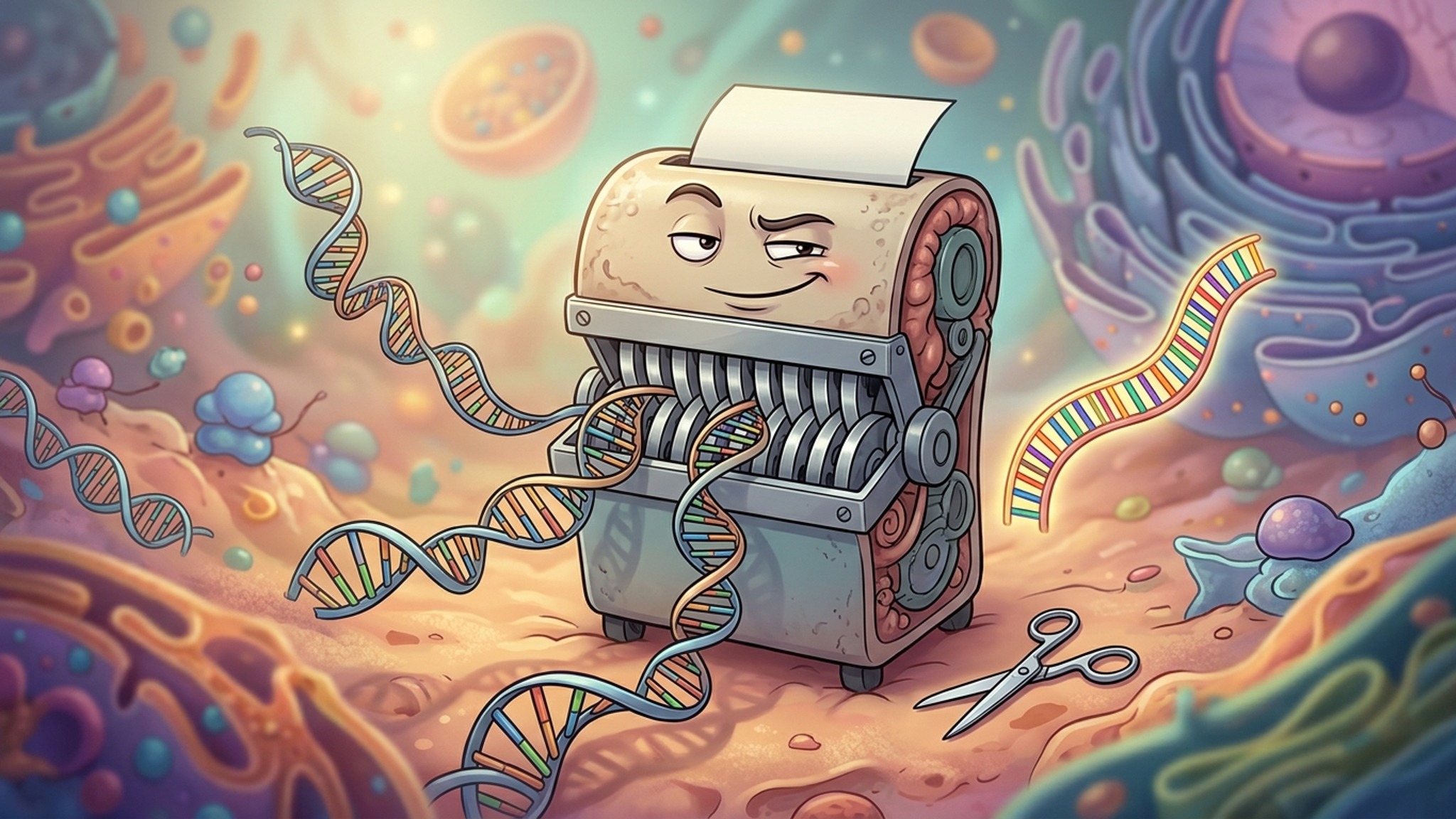
Inside a tiny test tube, a locked molecular machine waits. It does not cut, make a sound, or give away any criminal intentions. Then one RNA strand touches it, carrying an exactly matching sequence.
Click.
The machine opens and starts chewing up the DNA around it. Not just one preselected address—lots of DNA. The cell stops growing.
Usually, this is the moment when someone yells, “Who left the shredder running?” The researchers asked a more interesting question: if only one particular password activates it, could they make it wake up specifically in cells they want to eliminate?
The moment the shredder wakes up
CRISPR is the name for a family of defense tools that originated in bacteria. These tools use guide molecules to find matching DNA or RNA sequences. RNA is a temporary working molecule that carries genetic instructions inside a cell.
Familiar CRISPR tools are often described as molecular scissors: the guide finds an address, and the tool cuts at the chosen spot. Cas12a2 is the family member who showed up to the meeting with completely different office equipment.
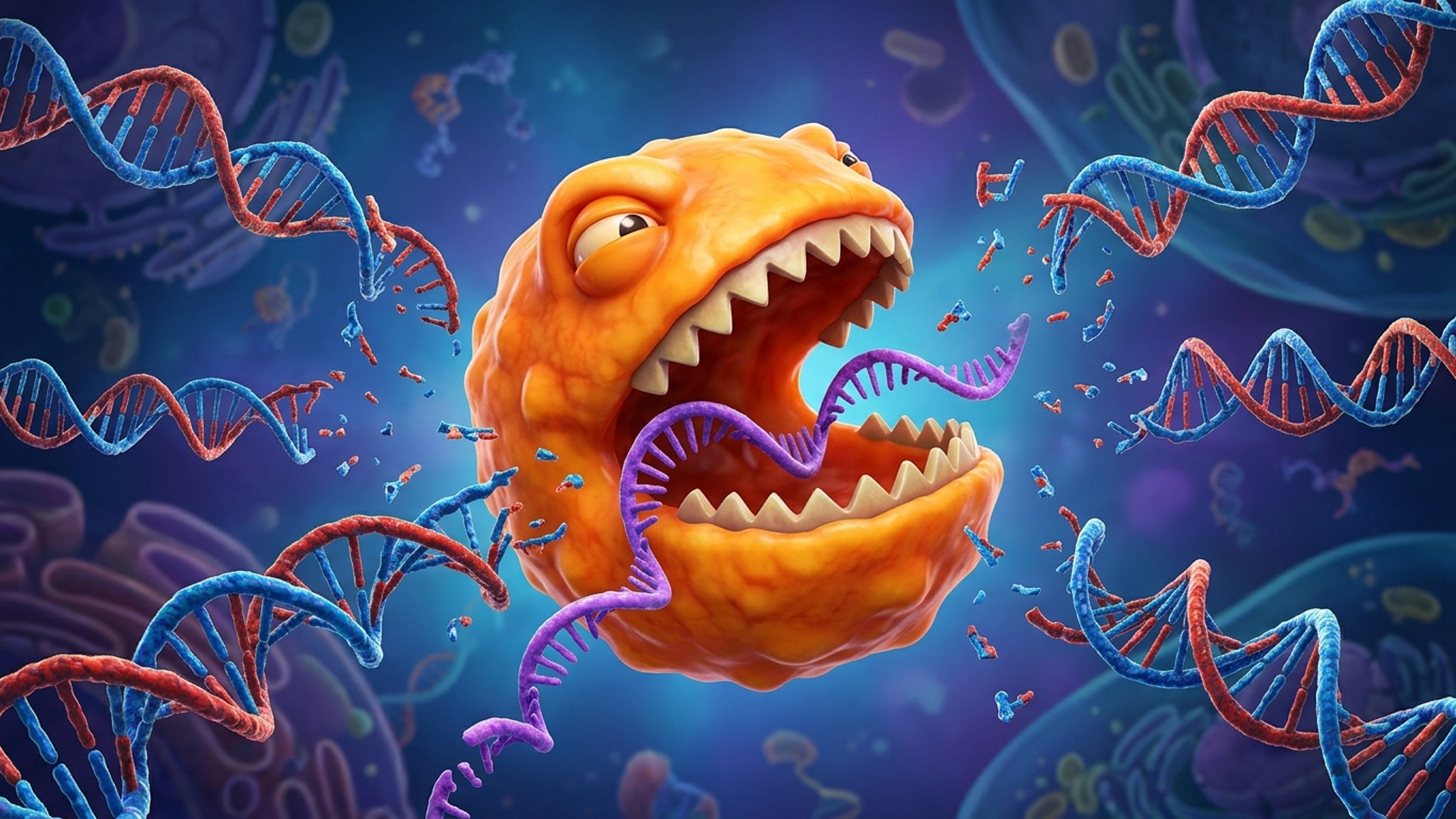
Biochemist Ryan N. Jackson of Utah State University and his colleagues set out to investigate how Cas12a2 works. The enzyme stays quiet until it recognizes target RNA with a matching sequence. That recognition opens its active state. From there, its behavior becomes much less polite: Cas12a2 chews up DNA in its surroundings without choosing each piece separately, and the cell stops growing.
The barcode is precise. The shredding that follows is broad. That is the difference to keep in mind, because the whole story depends on it.
TL;DR
- CRISPR is a family of bacterial defense tools that find matching DNA or RNA sequences.
- Cas12a2 switches on in response to a particular target RNA—then indiscriminately shreds nearby DNA.
- The researchers tested whether mutant TP53 RNA could serve as a selective activation password.
- These are early laboratory results, not proof of a safe or effective treatment in humans.
The password written into TP53
This is where TP53 enters the story. It is the gene that carries the instructions for making p53, a transcription factor—a protein that helps determine which genetic instructions get read in a cell. According to the preprint, p53 carries a mutation in about 40% to 50% of cancer cases. That is a serious reason to investigate whether RNA made from a mutant version of TP53 could serve as an activation barcode.
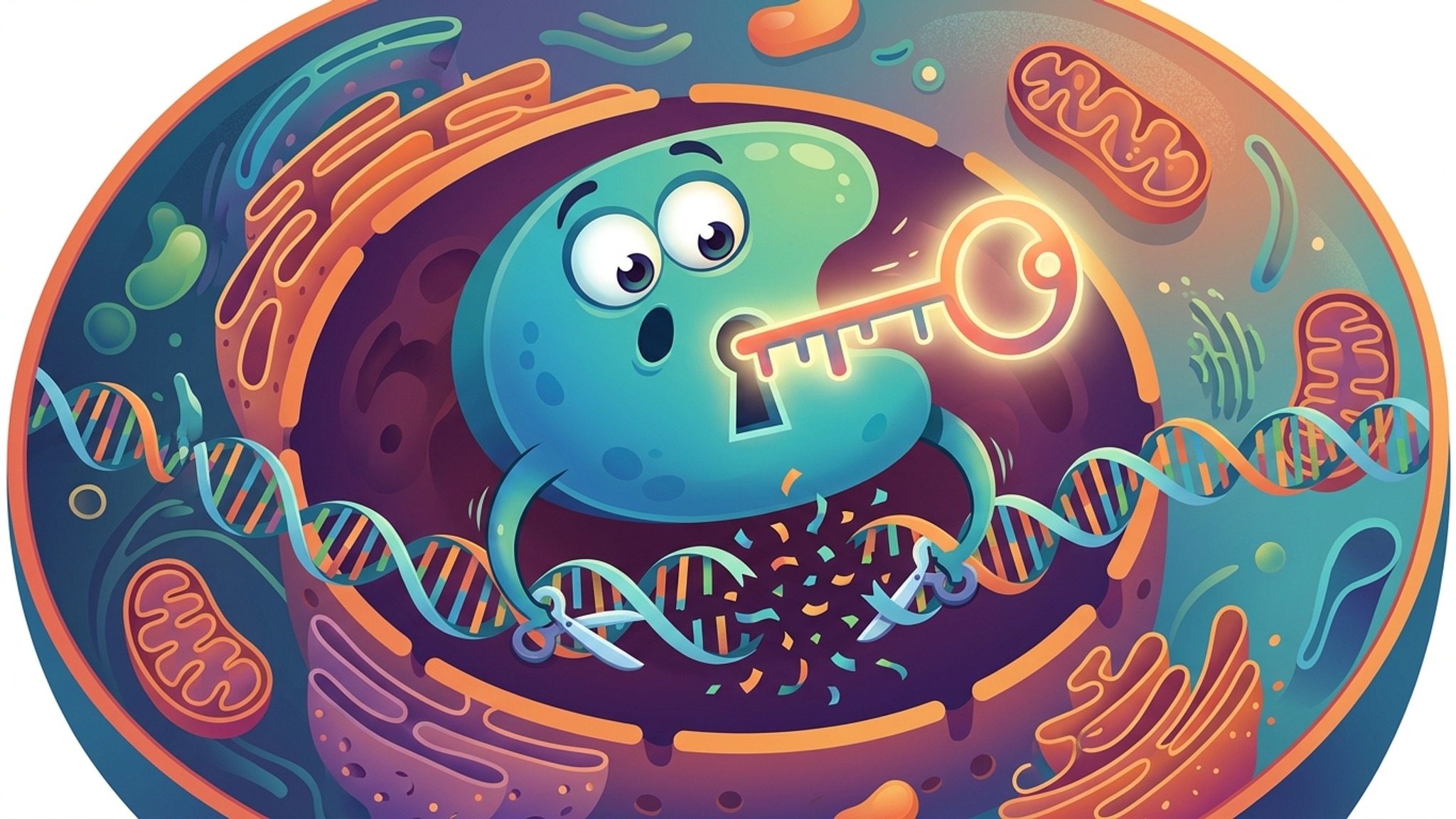
In the study, whose authors include Jennifer A. Doudna, the researchers tested this idea: preparing Cas12a2 to recognize mutant TP53 RNA. As long as the barcode does not appear, the shredder is supposed to stay locked. When the mutant RNA matches the target, the enzyme activates and begins broadly destroying DNA inside the cell.
In the experiment described, target cells carrying the mutation were eliminated, while cells without the activation sequence remained unharmed. The elegance here is not that the shredder became gentle. Nobody sent it to manners school. The control is in the lock: which RNA can activate it, and in which cell that RNA appears.
What was actually tested?
This is where we turn off the superhero music and switch on the lab’s unflattering white light.
The research on eliminating cells carrying mutant TP53 was published as a preprint on bioRxiv. That means the work can be read before it has completed peer review—a formal evaluation by other scientists. That is useful, but it also means the results are preliminary and could change after further testing.
The Nature article explains the Cas12a2 mechanism and describes early laboratory and preclinical research. It is science journalism, not the main paper on the TP53 experiment. So the accurate headline is not “A cancer cure has been found.” What was tested was whether one particular mutant RNA could trigger broad DNA destruction in target cells, and whether cells without the activation password would remain unharmed under the experimental conditions.
It is an intriguing result. It just still lives in a laboratory, not a hospital.
From the lab to the fine print
Activating a DNA shredder inside a cell sounds impressive for exactly the same reason it sounds dangerous: once activated, the destruction is not gentle. This approach has not been shown to be safe or effective in humans. A cell experiment alone cannot tell us what would happen in a living body, how the tool would reach the right cells, or whether healthy tissue would remain protected.
Akribion Therapeutics is developing a Cas12a2-based treatment aimed at HPV-driven head and neck cancers. The company aims to obtain clinical-trial data by 2030. That is a development target set by the company, not a clinical result already achieved. A future date wearing a lab coat is still not evidence.
The dinner-table test
Before you scroll, try answering this: what is more precise about Cas12a2—the choice of when it activates, or the cutting that follows?
The answer is the moment of activation. The target RNA is the precise barcode; after recognition, the DNA shredding is broad. If you managed to explain that without turning the napkin into a shredder, you passed.
So, what should you take away from this?
Cas12a2 flips the familiar picture of CRISPR. Instead of scissors making a targeted cut, there is a precise lock connected to a shredder with no manners. Mutant TP53 RNA may be the password that activates it in target cells—at least in the early laboratory experiments described.
Now comes the truly hard question: can this lock be controlled inside a living body so that the shredder opens only in the right room? Until there is an answer from humans, we have a strange and promising research mechanism—not a medicine, not a promise, and definitely not permission to leave the shredder unsupervised.