 Michael wanted to understand
The Scraped-Knee Security Breach
A scraped knee turns into a tiny security incident: barriers break, immune patrols rush in, T and B cells coordinate, and the body learns what to remember next time.
BioWadi
BioWadi team
Published
July 17, 2026
Reading time
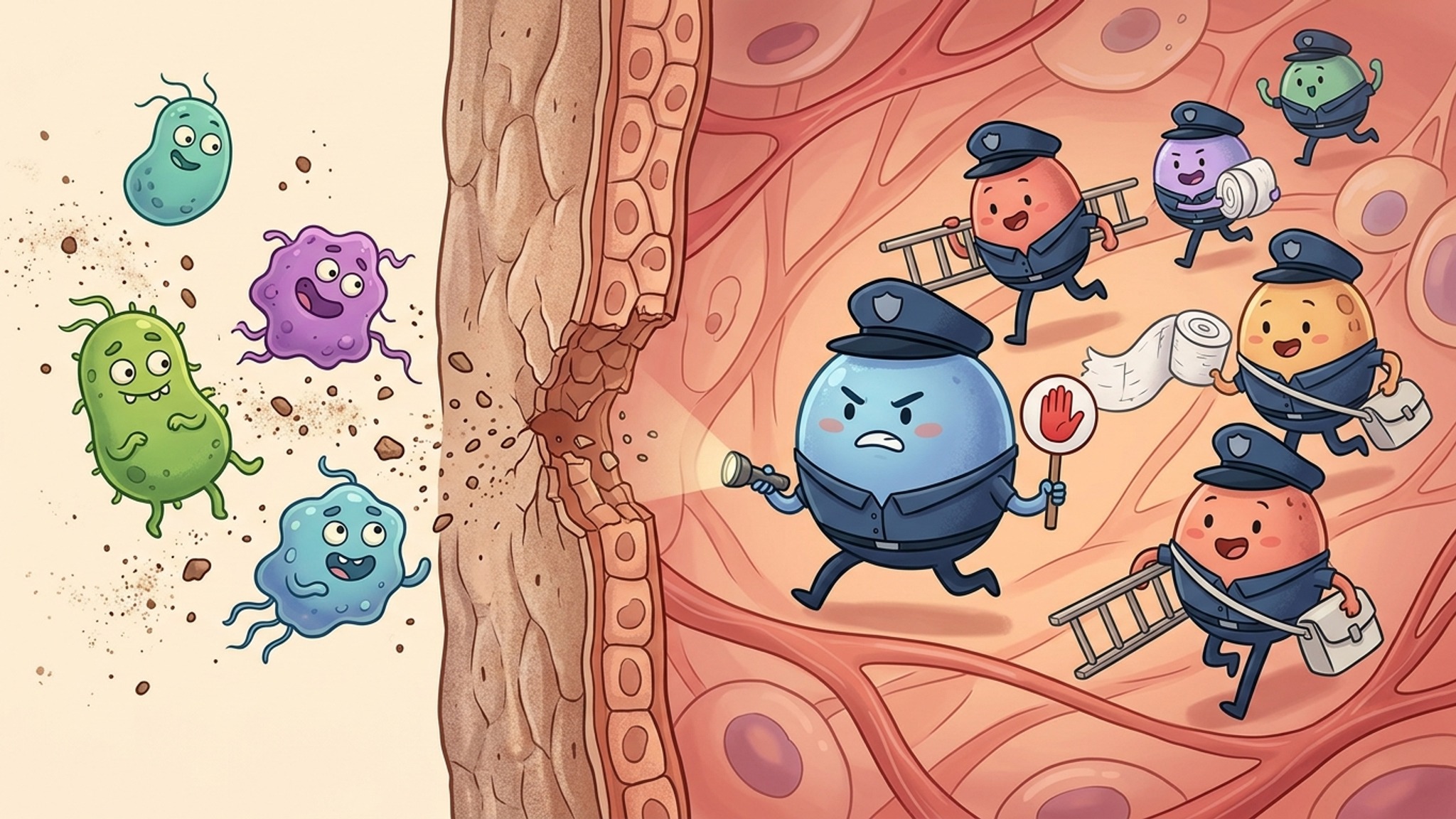
The kid climbs the playground structure as if someone appointed him the official inspector of gravity. One foot slips. The knee meets gravel. There is one quiet second in which the surrounding adults calculate whether this is a normal scrape or a three-act tragedy with a bandage at the end.
From the outside: a little blood, a little dirt, an offended face.
From the inside: a hole has opened in the body's fence, and a security team that does not take weekends, holidays, or coffee breaks is already sprinting to the scene.
The Breach at Knee Gate
Skin is not wrapping paper the body wears so we do not look like soup with shoes. It is a barrier. A wall. A gate. Most of the time it simply stands there and stops bacteria, dirt, and other uninvited guests from getting in. Mucous membranes, like those in the nose and mouth, are also part of this border system: wet zones that try to stop invaders before the plot gets dramatic.
But gravel is gravel: small, sharp, and convinced it is an important supporting character. It opens a passage. Things from outside get in.
The body does not pause to draft a procedure. It activates the innate immune system: the fast patrol team, the one that responds first to anything that looks out of place. It does not need to know exactly who the invader is or read its biography. At this stage, it is enough to understand: something here is not supposed to be here.
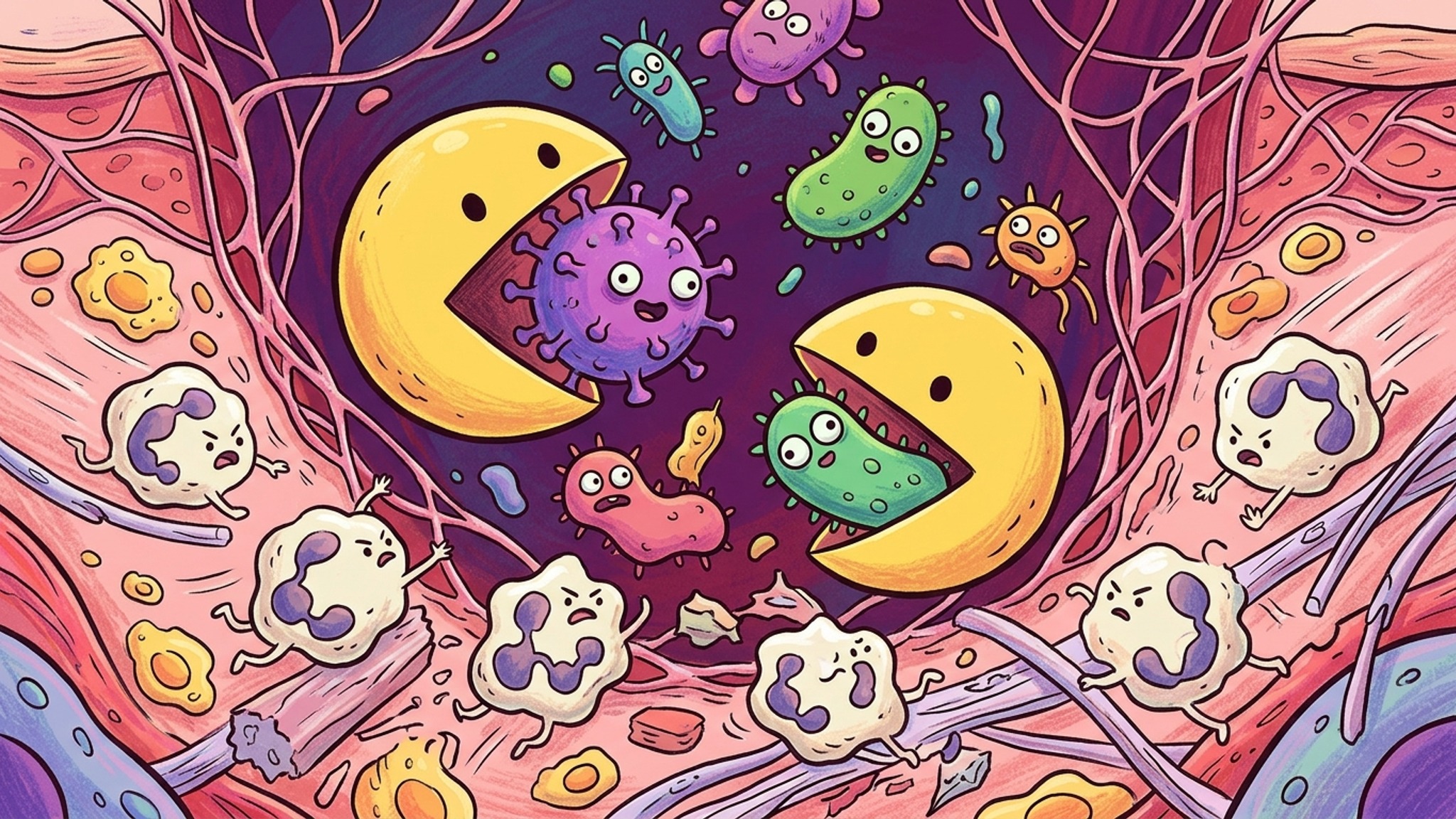
Macrophages and neutrophils, two types of white blood cells, arrive in the area. A macrophage is a security guard with a pretty extreme solution: it does not escort the troublemaker out. It swallows it. Pac-Man with an employee badge.
Neutrophils are the patrol that arrives fast, works hard, and leaves behind a scene that looks like someone tried to clean with syrup. That is why the scraped area can look red, warm, and swollen: not because the knee is insulted, but because cells, proteins, and emergency messages are gathering there to close the breach.
TL;DR
- A scrape is not just an ouch: it is a breach in the body's outer barrier.
- The innate immune system arrives first: fast, strong, and not always elegant.
- Cytokines are chemical radio calls between security teams.
- T and B cells do not replace the patrol; they talk with it all the time.
The Radio Call to Headquarters
Even a fast team can become chaos if everyone runs in every direction and screams at a dust speck as if it were a supervillain. So immune cells send one another cytokines: short chemical messages that say come here, turn up the activity, calm down, or please stop acting like a cracker crumb is an intergalactic invasion.
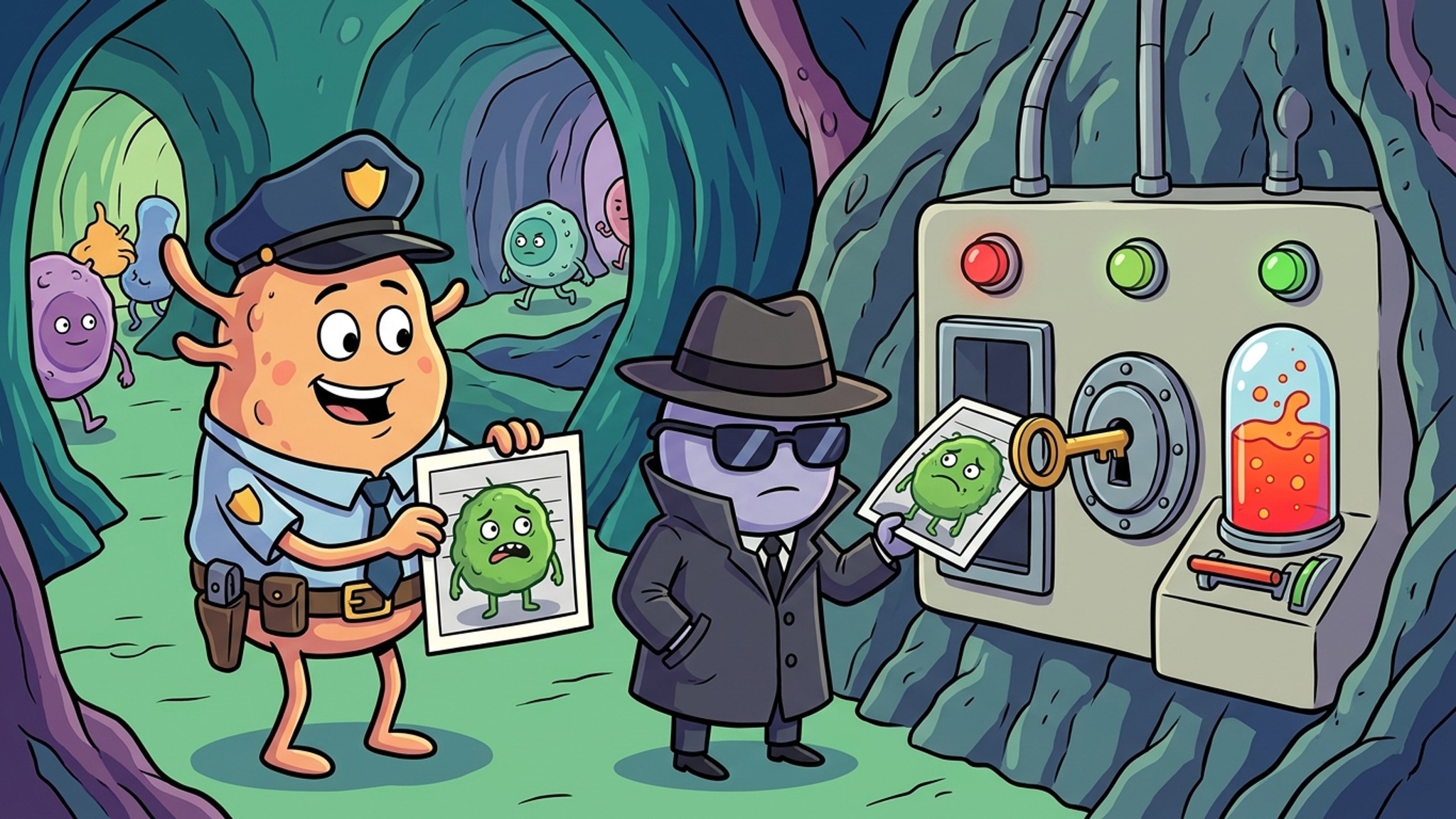
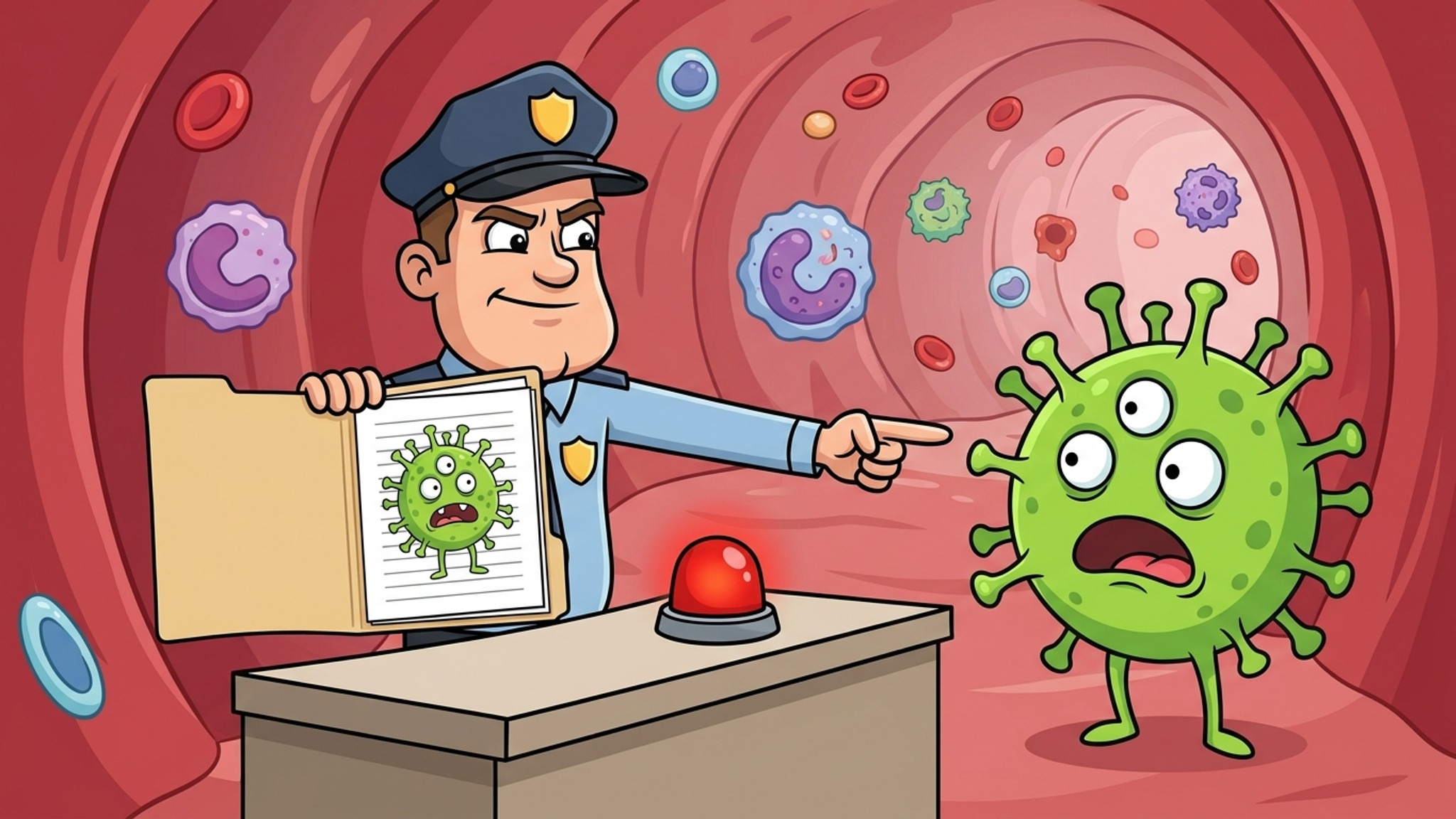
If the breach is small, much of the work stays out on the street. But when a more precise response is needed, an important courier appears: an antigen-presenting cell. An antigen is a small identifying mark on the invader, like a suspect photo. The presenting cell collects that sign and carries it to a lymph node, which is basically a late-night police station with a suspect board, bad coffee, and cells that cannot say: sorry, we are closed.
That is where the adaptive immune system enters the picture: the more specialized part of security, the one that is not satisfied with I saw something weird near the trash can.
A T Cell Does Not Jump at Every Shadow
At headquarters, T cells are waiting. But a T cell is not supposed to act just because someone puts a suspect photo in front of it. That is too dangerous. Activating it requires several approvals together: a match to the antigen being shown, an extra encouragement signal, and cytokines that steer the type of response.
In less fancy English: the guard needs a matching suspect photo, a secret handshake, and a radio message from the shift. Without that, the guard stays put.
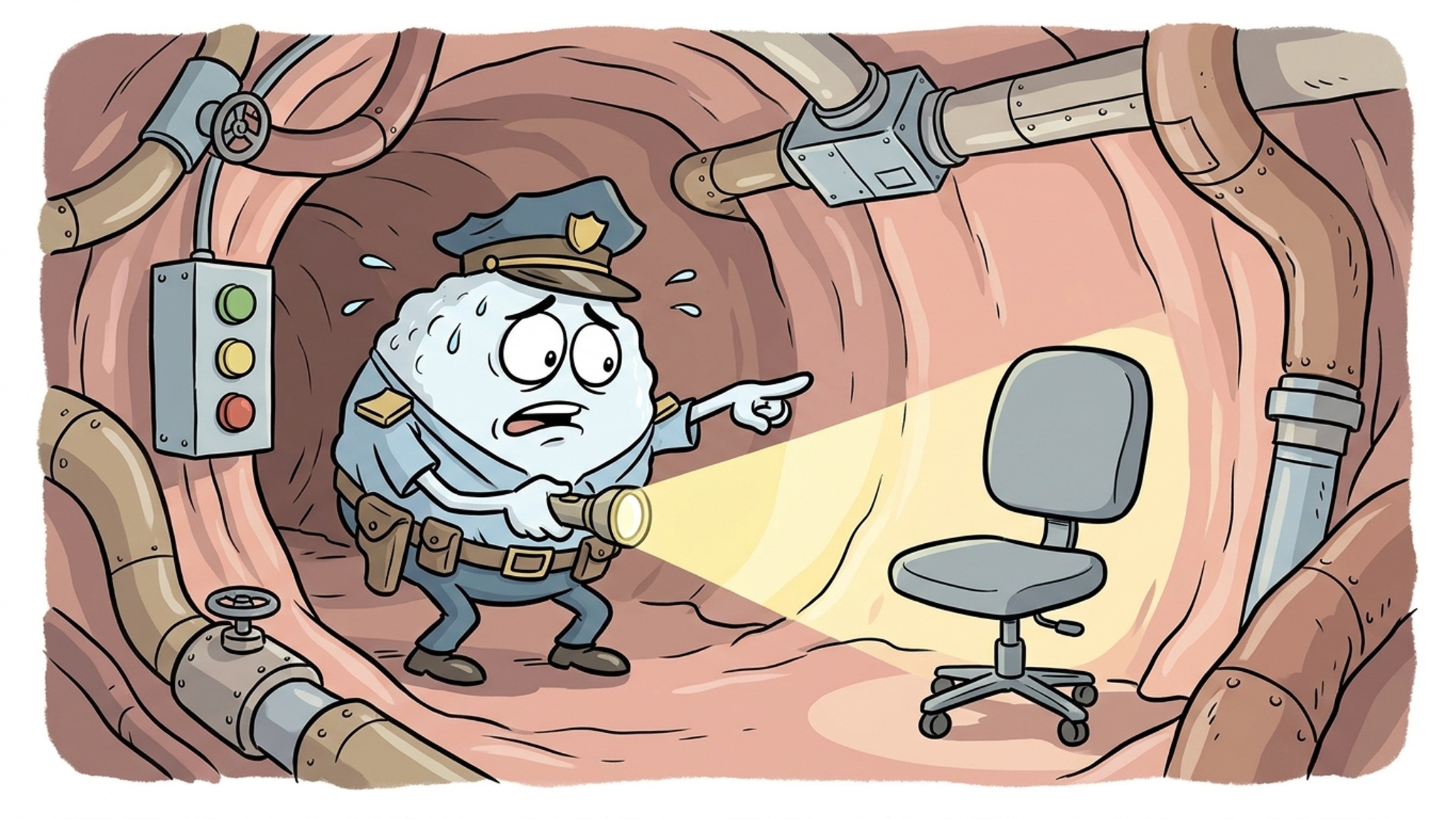
And that is good. If every T cell charged at everything with a suspicious vibe, the immune system would also deal with dust, lunch, and a chair that looked a little too confident. A good immune system needs to know how to attack, but also when not to wreck the building it is supposed to protect.
The Wanted-Poster Print Shop
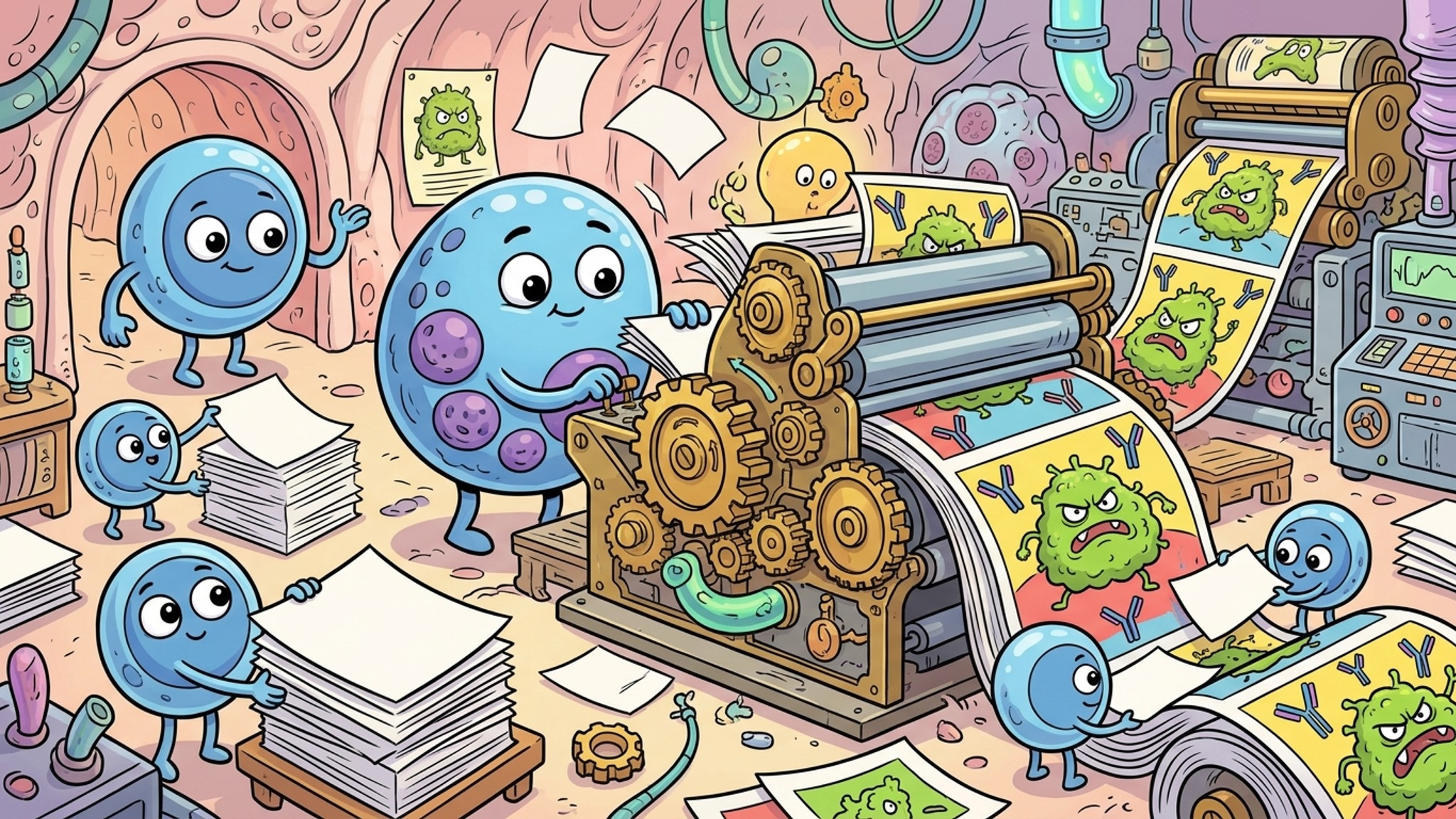
After the threat becomes clearer, B cells enter the story. Some of them can become plasma cells, and that is no longer street patrol. That is an irritated print shop.
What does it print? Antibodies.
An antibody is a protein matched to a specific target. In our security metaphor, it is like a wanted poster or a marker tag that sticks specifically to this invader, not to everyone who looks vaguely round and annoying. Antibodies help mark the target so the immune system can handle it better.
Here you can see the difference: the innate system says, quickly, something strange got in, everybody move. The adaptive system is slower at first, but once it identifies the suspect, it can work with higher precision.
This Is Not a Relay Race
The too-easy version goes like this: first the innate system runs, then it hands the baton to the adaptive system, and then it goes home to watch a show.
Convenient. Clean. Not really true.
The street and headquarters stay on the same radio channel. Antigen-presenting cells bring information from the field. Cytokines pass along calls, instructions, and directions. The more precise response feeds back into what is happening at the breach site. This is not a chain of now it is your turn. It is a living security network, with updates going back and forth, because real bacteria have not read the textbook and do not know how to wait their turn.
The File Left in the Archive
Eventually the knee calms down. A scab forms. The redness fades. The kid has already forgotten the tragedy because he found a stick that looks like a sword, and now someone probably needs to defend the kingdom from a bench.
But the body has not forgotten.
Some B and T cells remain as memory cells. They do not remember the drama, the gravel, or the fact that someone said it is nothing and that definitely did not help. They keep a file on a certain biological sign. If the same antigen appears again, the response can be faster, because the whole investigation does not need to start from zero.
That is one of the immune system's clever tricks: it does not remember stories. It remembers signs.
When the Guard Suspects the Chair
Here the story stops being the immune system is amazing, applause, go home. A security system has to know not only who is foreign, but also who belongs in the building.
When the ability to tell the body apart from invaders breaks down, the immune system may get confused and attack healthy cells, tissues, or organs as if they were enemies. That is a general description of autoimmune disease: not an invasion from outside, but a mistaken identity from inside.
In our metaphor, it is the guard who once stopped a real burglar and now lunges every night at the cleaning cart because it looked suspicious. Funny as an image. Much less funny as biology.
That is why the brakes matter. An immune system that is too weak may give invaders time. An immune system that is too strong in the wrong place may damage the home it is supposed to protect.
Where Does the Research Enter the Story?
Here we need to do something the internet likes less: not act as if everything was discovered yesterday morning.
The source for this story is a peer-reviewed review article. In other words, it is not one single experiment proving the whole immune system by itself, but a summary of broad scientific knowledge: barriers, white blood cells, cytokines, T and B cells, antibodies, immune memory, and the ongoing connection between the parts.
The picture that comes out of it is not a magic button labeled kill bacteria. The body uses organs, cells, proteins, and chemical messages to protect against invaders and abnormal cells, while also trying to reduce damage to itself. It is less superhero with a cape, and more control room that never gets a day off.
Where the Magic Ends and the Biology Begins
This is not medical guidance for scrapes, vaccines, diseases, or treatments. It also does not mean autoimmune diseases are a tiny mix-up that can be explained in one line. We are talking here about a general mechanism: identify danger, respond, remember, and know when to stop.
Dinner-table question: If you were designing a security system for the body, would you prefer a fast team that sometimes makes mistakes, or a slow team that checks everything three times?
So, What Should You Take From This?
The knee heals. The bandage gets thrown away. The kid returns to the playground structure, because kids are small people who look at gravity and say: one more round.
But behind the scenes, the shift is not over. The barriers are still standing. The patrol is still listening on the radio. Headquarters is still open. And in some quiet biological folder, a suspect photo is saved for next time.
You can forget the scrape. Your security team does not really go on break.