 Michael wanted to understand
The Midnight Fridge, the Desert Monster, and the Hormone Everyone Is Arguing About
A geeky BioWadi guide to GLP-1, semaglutide, Ozempic, Wegovy, type 2 diabetes, weight data, hype, caveats, and one very suspicious fridge.
BioWadi
BioWadi team
Published
July 8, 2026
Reading time
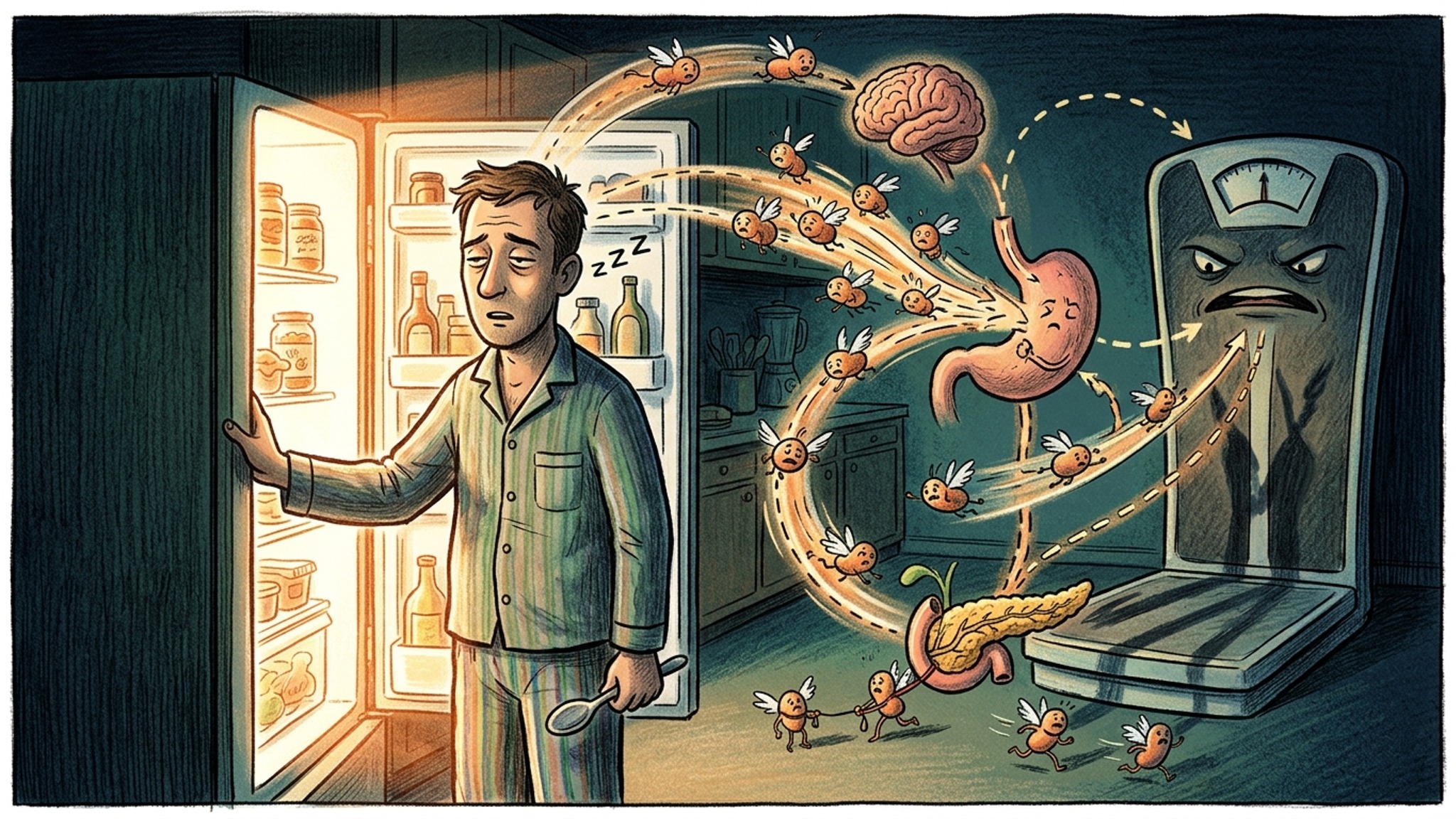
You are standing in front of the fridge at night. Not a normal fridge, obviously. A multidimensional portal of yellow cheese, hummus, half a sad cucumber, and one mysterious container nobody in the house is willing to open because it may already have developed political opinions.
Your hand reaches forward. Your brain says, “Just checking what’s there.” Your stomach says, “I don’t know who you people are, but I support this.” And then, backstage, somewhere in the intestines, pancreas, and brain, a biological messaging system starts arguing over the most household question after “Who left the air conditioner on?”: are we actually hungry, or is the body just managing us like an annoyed building committee?
Into this scene walks a word that sounds like someone forgot their computer password: GLP-1. Next to it come names that became stars of news reports, living-room conversations, WhatsApp groups, and articles with pictures of injection pens as if they were magic swords: semaglutide, Ozempic, Wegovy.
But the real story is less like magic and more like a control system. Not a “be thin” button. Not a character test. Not a miracle sticker. More like a small chemical message that arrives in the body’s control room, drops a note on the desk, and says: wait, we ate. You can lower the intensity now.
TL;DR
- GLP-1 is a hormone that signals the body about food, fullness, and blood sugar. Medicines like semaglutide imitate part of that action through GLP-1 receptors.
- Ozempic was approved by the FDA in 2017 for adults with type 2 diabetes. Wegovy, also semaglutide but in a different regulatory context, was approved in 2021 for chronic weight management in defined populations.
- In the STEP 1 trial, certain adults without diabetes by HbA1c lost an average of about 15.6% of body weight with semaglutide 2.4 mg once weekly, compared with about 2.8% with placebo, alongside diet and activity intervention.
- That does not mean the medicine is suitable for everyone, does not mean every person will get that result, and does not erase side effects such as nausea, diarrhea, vomiting, and constipation listed in the Wegovy label.
The Desert Monster That Walked Into the Pharmacy
Like many good science stories, this one does not begin in a shiny pharmaceutical office. It begins with a creature that looks as if someone designed it after a sleepless night: the Gila monster. A heavy venomous lizard that lives in the deserts of North America and looks like it knows secrets about your digestive system and will not share them for free.
Inside its venom, scientists found a peptide called exendin-4. A peptide is a small chain of protein building blocks, a kind of biological text message. And this message behaved in an interestingly similar way to human GLP-1. What do scientists do when they find, in a desert lizard, a substance that resembles an important human hormone? Correct: first they get cautiously excited, then they test it, then they try to turn it into something usable without inviting a lizard to a clinical appointment.
That line led to exenatide, a medicine sold under the names Byetta and Bydureon, approved by the FDA in 2005. In other words, before everyone was talking about semaglutide at adult birthday parties, there was an older story here: type 2 diabetes, gut hormones, and a very strange lesson from a desert animal.
And that is already an important clue: these medicines were not born first as “weight-loss shots.” They grew out of an attempt to understand how the body manages sugar, insulin, and fullness. Then came public attention, and then came the usual roller coaster: excitement, money, shortages, rumors, headlines, and people talking about receptors as if they had invited them to a bar mitzvah.
What Is GLP-1 Even Telling the Body?
Imagine the body as a giant building with a messy control room. On one floor sits the pancreas, one hand on the insulin buttons. On another floor, the brain receives reports about hunger and fullness, but also about the smell of pizza from the street, stress, habits, bad sleep, and everything that makes a grown adult open a drawer and find “just one square of chocolate,” which somehow becomes a search expedition.
GLP-1 is one of the messengers in this system. It is released in the digestive system after food, participates in signals connected to fullness, and also affects responses related to blood sugar. But natural GLP-1 in the body does not stick around forever. It is not a government clerk with tenure. It knocks on the door, delivers an envelope, and already the biochemical shredder in the hallway is starting to work.
This is where medicines that activate the GLP-1 receptor come in. A receptor is like a lock or a button on cells. If the right substance connects to it, something happens. Semaglutide is a GLP-1 receptor agonist: it activates that receptor in a way that imitates part of GLP-1 signaling, but is designed to last longer than the natural hormone’s brief response.
Translation from metaphor to reality: the medicine does not “burn fat” like a tiny dragon in the belly. It changes signals. In some people, those signals can reduce appetite and affect weight. But hunger and weight are not only character and not only choice. They are part of a complicated biological system that talks with food, sleep, medicines, genetics, environment, illness, stress, money, and time. In short, the body is not an app with a restart button.

Why Did This Start With Type 2 Diabetes, Not Weight?
Type 2 diabetes is a condition in which the body has trouble managing blood sugar normally, partly through problems connected to insulin and the response to it. That is why the GLP-1 system interested researchers and doctors so much: it sits exactly at the junction where food enters, blood sugar changes, and the pancreas needs to respond.
Ozempic, the familiar brand name for semaglutide in this context, was approved by the FDA in 2017 for adults with type 2 diabetes. That detail matters, because online it is easy to mix names the way socks get mixed after laundry. Ozempic is not the same regulatory story as Wegovy. Both are connected to semaglutide, but their approvals are not identical.
Wegovy was approved by the FDA in 2021 for chronic weight management in adults with obesity, or with overweight and at least one weight-related condition, together with a reduced-calorie diet and increased physical activity. That last sentence matters, even if it sparkles less than “the shot driving the world wild.” The approval does not mean: anyone who wants it can use it alone, without a doctor, without context. It means: there is a defined population, defined conditions, a label, warnings, medical follow-up, and side effects.
And here comes a small dinner-table quiz: what is more interesting to know about a medicine: what it is called in an advertisement, or exactly which people it was tested in? The less sparkly answer is also the one that prevents nonsense.
Who Pays for This Whole Circus?
Once science touches weight, diabetes, and appetite, it does not stay only in the lab with test tubes and silence. It walks out the door, passes the doctor, insurer, regulator, and factory, and then lands on social media, the place where a complicated idea gets sunglasses and is sent to dance on a table.
Who needs it? People with type 2 diabetes, and people in certain chronic weight-management populations as defined in the Wegovy approval. Who might pay? Health systems, insurers, patients, sometimes countries, depending on the place and rules. Who might profit? Companies that develop, manufacture, and market these medicines. Does that mean the science is fake? No. Does it mean the science is sacred? Also no.
Money does not turn science into a lie. Money also does not turn it into truth. Money simply means: now everyone is watching. So it is worth looking more carefully.
Because when there is huge demand, there is also hype. When there is hype, some people tell only the shiny part. When they tell only the shiny part, the medicine label, the population studied, side effects, and fine print get left behind like a kid forgotten in the pickup van. And that is exactly where BioWadi likes to stop, turn on a flashlight, and ask: wait, what did they actually test?

The Impressive Numbers, and the Fine Print
Here we have to do something the internet likes less: look at a study.
In the STEP 1 trial, listed as NCT03548935, 1,961 adults participated. Participants had a BMI of 30 or higher, or 27 or higher with a weight-related medical condition. People with an HbA1c level indicating diabetes were not included. Participants were randomly assigned in a 2:1 ratio: one group received semaglutide 2.4 mg once weekly for 68 weeks, and another group received placebo. None of this happened in empty space; the treatment also came with a diet and physical activity intervention.
According to trial results published in the ClinicalTrials.gov record, the average change in body weight from baseline to week 68 was about a 15.6% decrease in the semaglutide group, compared with about a 2.8% decrease in the placebo group.
That is a big number. It explains why people started staring at this field with round eyes. But an average number is not a personal promise. An average is like classroom weather: it may be pleasant on average, while someone by the window is freezing and someone by the air conditioner is melting. The trial tested a certain group, under certain conditions, for a certain time, with certain criteria. It does not say every person will get the same result. It does not say the treatment is suitable for everyone. And it does not say you can ignore the label, the doctor, or side effects.
The fine print is not legal decoration. It is the part where the science story takes off its shiny jacket, sits across from you with a binder, and says: now we really read.
Where the Magic Ends and the Biology Begins
At this point it is easy to fall into two opposite kinds of nonsense.
The first nonsense: “It’s magic, everyone needs it.” No. Wegovy is a prescription medicine with defined use populations, warnings, and side effects. The FDA label for Wegovy lists nausea, diarrhea, vomiting, and constipation among common side effects. Those are not small words when you are the person experiencing them. The digestive system, it turns out, does not always appreciate someone walking into its control room and moving buttons.
The second nonsense: “If there is an injection, then everything is only biology and habits, environment, or decisions do not matter.” Also no. Biology does not cancel the world; it explains why the world is not simple. People do not live inside an orderly trial with tables, follow-up visits, and clean rows in a spreadsheet. They live with work, family, money, stress, available food, sleep, other medicines, medical history, and a fridge glowing like a spaceship at an unreasonable hour.
The smarter version is this: GLP-1 receptor agonists are an important medical tool in certain contexts. They rest on a real biological mechanism. They have been tested in trials. They are also not a joke, not a makeup trend, not a universal solution, and not an excuse to mock anyone.
There is no medical advice here. There is a lesson in reading a science story: first understand the mechanism, then who was tested, then what the result was, and then what is unknown or not suitable for everyone.
Wait, So What Should You Take From This?
We are back at the fridge. The light is still there. The hummus is still silently judging you. But now there is another character in the scene: not willpower with cartoon muscles, but a whole signaling system, with hormones, receptors, brain, pancreas, intestines, regulators, trials, and companies smelling a huge market.
GLP-1 is not a magic word. Semaglutide is not a button that deletes complexity. Wegovy is not the same thing as a headline about “weight-loss injections,” and Ozempic is not the generic name for the whole story. These are medicines with history, mechanisms, different approvals, impressive data, cautious labels, and real side effects.
The best lesson here is not “good medicine” or “bad medicine.” That is too easy, and therefore suspicious. The lesson is that biology runs conversations we can barely hear: between the intestines and the brain, between sugar and insulin, between hunger and habit, between research and money.
And whoever understands that conversation is less likely to fall for the first yelling headline sprinting across the screen.